The Sun
The Sun is a yellow dwarf star (G2V), about 4.6 billion years old, and the dominant gravitational force in the Solar System. It has a diameter of roughly 1.4 million kilometers and contains around 99.8% of the Solar System’s mass. Nuclear fusion in its core converts hydrogen into helium, producing energy that warms the planets. Above the core lie the radiative and convective zones, followed by the visible photosphere (~5,500 °C), the chromosphere, and the much hotter corona (~2 million °C).
Source: science.nasa.gov
APODs including "The Sun"
Planets Around a Total Eclipse
10/04/2024
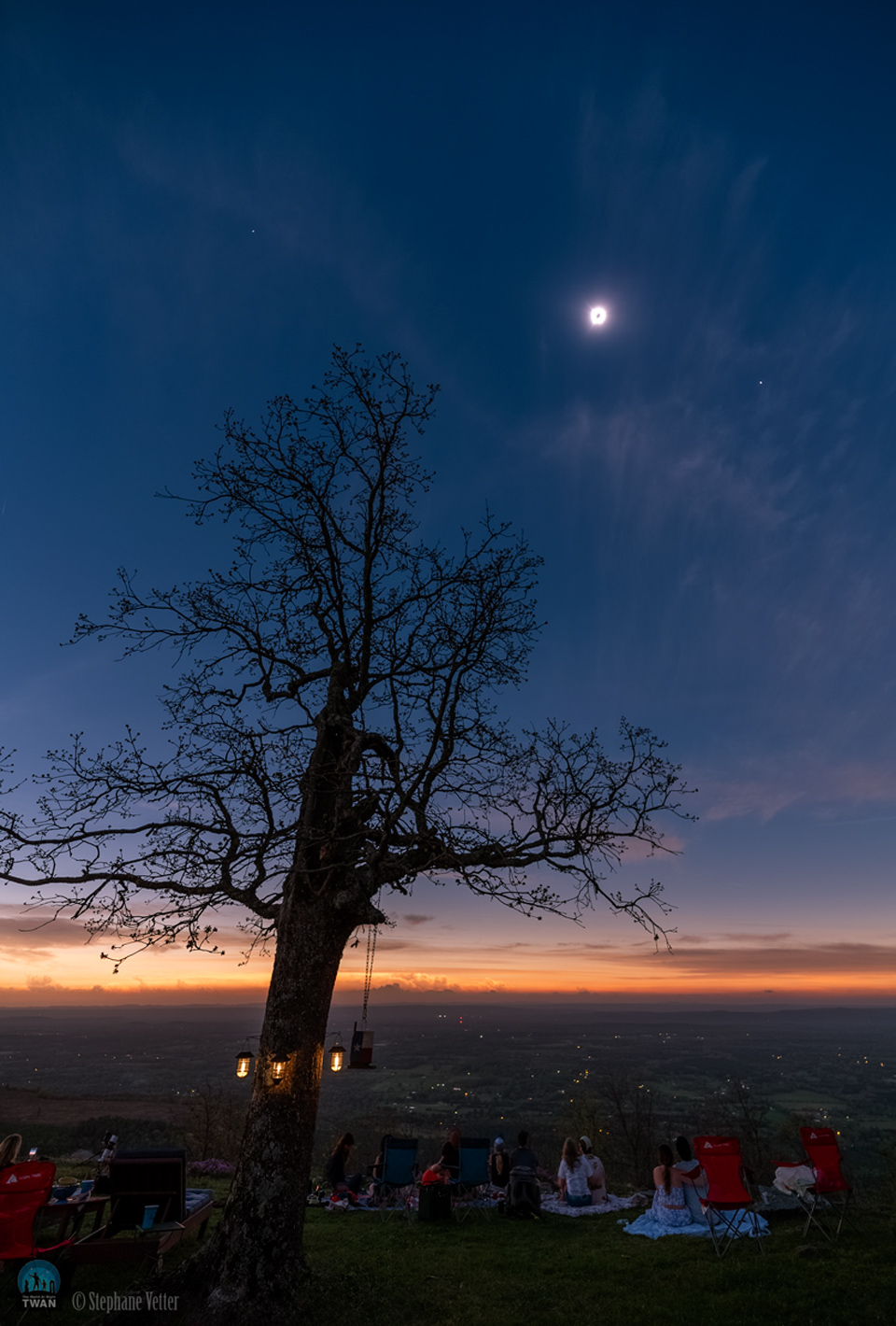
What wonders appear when the Moon blocks the Sun? For many eager observers of Monday’s total eclipse of the Sun, the suddenly dark sky included the expected corona and two (perhaps surprise) planets: Venus and Jupiter. Normally, in recent days, Venus is visible only in the morning when the Sun and Jupiter are below the horizon, while Jupiter appears bright only in the evening. On Monday, though, for well-placed observers, both planets became easily visible during the day right in line with the totally eclipsed Sun. This line was captured Monday afternoon in the featured image from Mount Nebo, Arkansas, USA, along with a line of curious observers — and a picturesque tree. Monday's Eclipse Imagery: Notable Submissions to APOD