The Sun
The Sun is a yellow dwarf star (G2V), about 4.6 billion years old, and the dominant gravitational force in the Solar System. It has a diameter of roughly 1.4 million kilometers and contains around 99.8% of the Solar System’s mass. Nuclear fusion in its core converts hydrogen into helium, producing energy that warms the planets. Above the core lie the radiative and convective zones, followed by the visible photosphere (~5,500 °C), the chromosphere, and the much hotter corona (~2 million °C).
Source: science.nasa.gov
APODs including "The Sun"
Total Totality
12/04/2024
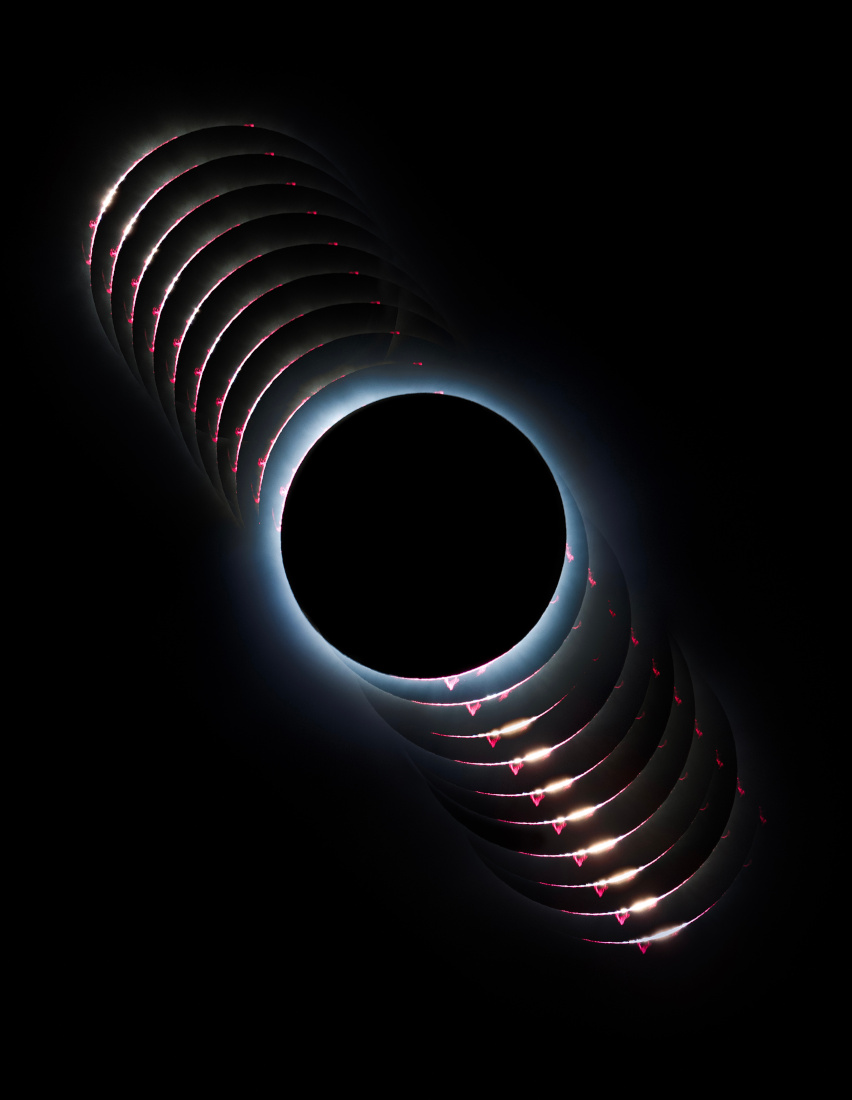
Baily's beads often appear at the boundaries of the total phase of an eclipse of the Sun. Pearls of sunlight still beaming through gaps in the rugged terrain along the lunar limb silhouette, their appearance is recorded in this dramatic timelapse composite. The series of images follows the Moon's edge from beginning through the end of totality during April 8's solar eclipse from Durango, Mexico. They also capture pinkish prominences of plasma arcing high above the edge of the active Sun. One of the first places in North America visited by the Moon's shadow on April 8, totality in Durango lasted about 3 minutes and 46 seconds. Solar Eclipse Imagery: Notable Submissions to APOD