The Sun
The Sun is a yellow dwarf star (G2V), about 4.6 billion years old, and the dominant gravitational force in the Solar System. It has a diameter of roughly 1.4 million kilometers and contains around 99.8% of the Solar System’s mass. Nuclear fusion in its core converts hydrogen into helium, producing energy that warms the planets. Above the core lie the radiative and convective zones, followed by the visible photosphere (~5,500 °C), the chromosphere, and the much hotter corona (~2 million °C).
Source: science.nasa.gov
APODs including "The Sun"
Palm Tree Partial Eclipse
13/04/2024
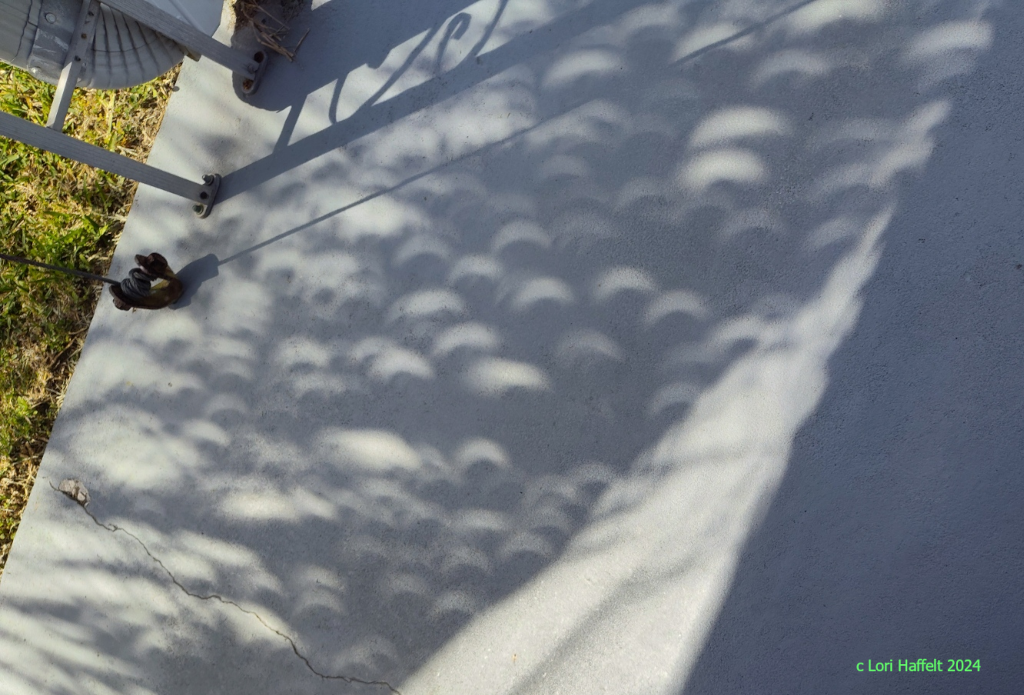
Only those along the narrow track of the Moon's shadow on April 8 saw a total solar eclipse. But most of North America still saw a partial eclipse of the Sun. From Clearwater, Florida, USA this single snapshot captured multiple images of that more widely viewed celestial event without observing the Sun directly. In the shade of a palm tree, criss-crossing fronds are projecting recognizable eclipse images on the ground, pinhole camera style. In Clearwater the maximum eclipse phase was about 53 percent. Solar Eclipse Imagery: Notable Submissions to APOD