The Sun
The Sun is a yellow dwarf star (G2V), about 4.6 billion years old, and the dominant gravitational force in the Solar System. It has a diameter of roughly 1.4 million kilometers and contains around 99.8% of the Solar System’s mass. Nuclear fusion in its core converts hydrogen into helium, producing energy that warms the planets. Above the core lie the radiative and convective zones, followed by the visible photosphere (~5,500 °C), the chromosphere, and the much hotter corona (~2 million °C).
Source: science.nasa.gov
APODs including "The Sun"
All Sky Moon Shadow
27/04/2024
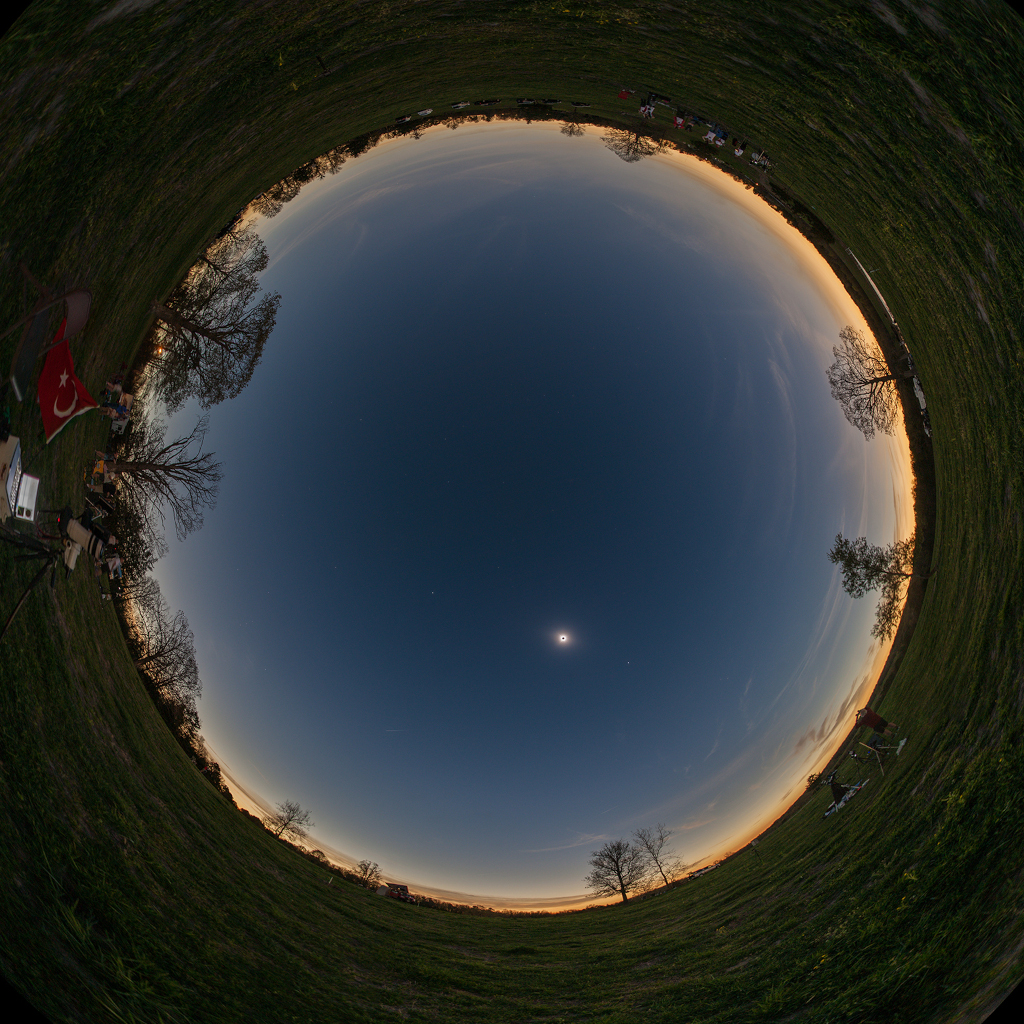
If the Sun is up but the sky is dark and the horizon is bright all around, you might be standing in the Moon's shadow during a total eclipse of the Sun. In fact, the all-sky Moon shadow shown in this composited panoramic view was captured from a farm near Shirley, Arkansas, planet Earth. The exposures were made under clear skies during the April 8 total solar eclipse. For that location near the center line of the Moon's shadow track, totality lasted over 4 minutes. Along with the solar corona surrounding the silhouette of the Moon planets and stars were visible during the total eclipse phase. Easiest to see here are bright planets Venus and Jupiter, to the lower right and upper left of the eclipsed Sun.