The Sun
The Sun is a yellow dwarf star (G2V), about 4.6 billion years old, and the dominant gravitational force in the Solar System. It has a diameter of roughly 1.4 million kilometers and contains around 99.8% of the Solar System’s mass. Nuclear fusion in its core converts hydrogen into helium, producing energy that warms the planets. Above the core lie the radiative and convective zones, followed by the visible photosphere (~5,500 °C), the chromosphere, and the much hotter corona (~2 million °C).
Source: science.nasa.gov
APODs including "The Sun"
AR 3664: Giant Sunspot Group
11/05/2024
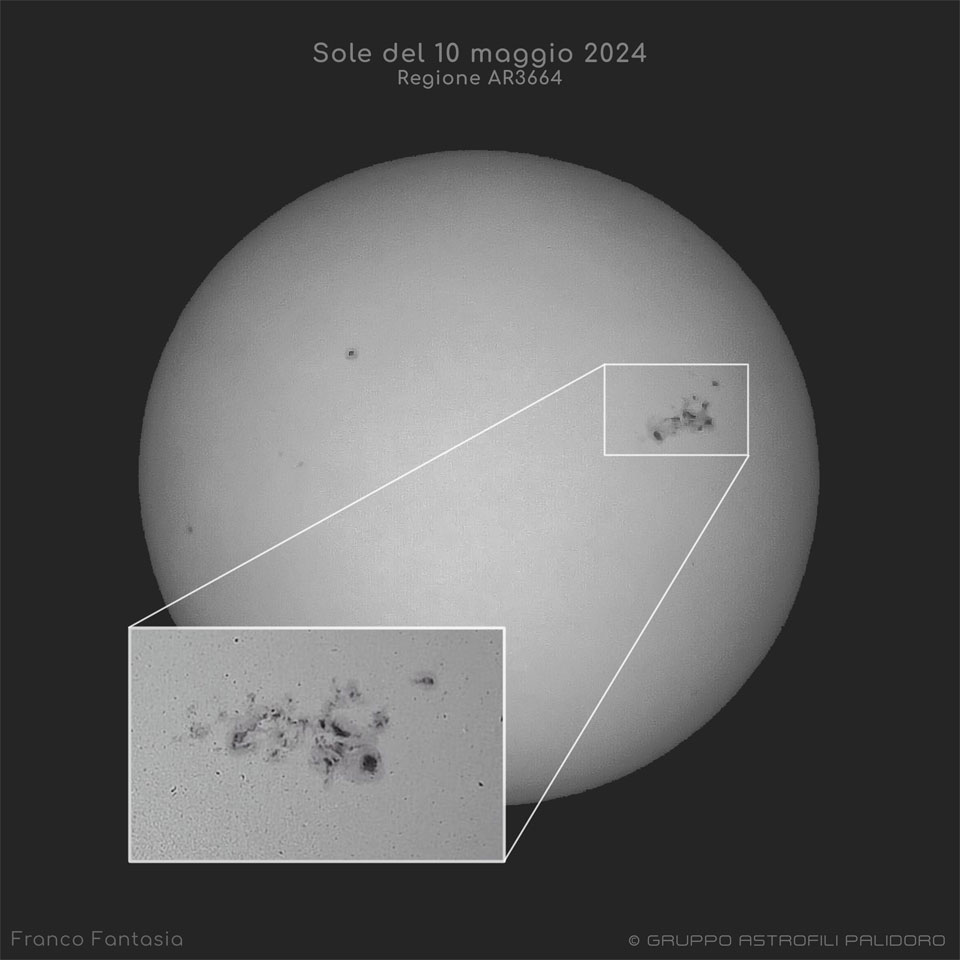
Right now, one of the largest sunspot groups in recent history is crossing the Sun. Active Region 3664 is not only big -- it's violent, throwing off clouds of particles into the Solar System. Some of these CMEs are already impacting the Earth, and others might follow. At the extreme, these solar storms could cause some Earth-orbiting satellites to malfunction, the Earth's atmosphere to slightly distort, and electrical power grids to surge. When impacting Earth's upper atmosphere, these particles can produce beautiful auroras, with some auroras already being reported unusually far south. Pictured here, AR3664 and its dark sunspots were captured yesterday in visible light from Rome, Italy. The AR3664 sunspot group is so large that it is visible just with glasses designed to view last month's total solar eclipse. This weekend, skygazing enthusiasts will be keenly watching the night skies all over the globe for bright and unusual auroras. Gallery: Active Region 3664 on the Sun and Associated Aurora