The Sun
The Sun is a yellow dwarf star (G2V), about 4.6 billion years old, and the dominant gravitational force in the Solar System. It has a diameter of roughly 1.4 million kilometers and contains around 99.8% of the Solar System’s mass. Nuclear fusion in its core converts hydrogen into helium, producing energy that warms the planets. Above the core lie the radiative and convective zones, followed by the visible photosphere (~5,500 °C), the chromosphere, and the much hotter corona (~2 million °C).
Source: science.nasa.gov
APODs including "The Sun"
Shadow of a Martian Robot
05/06/2024
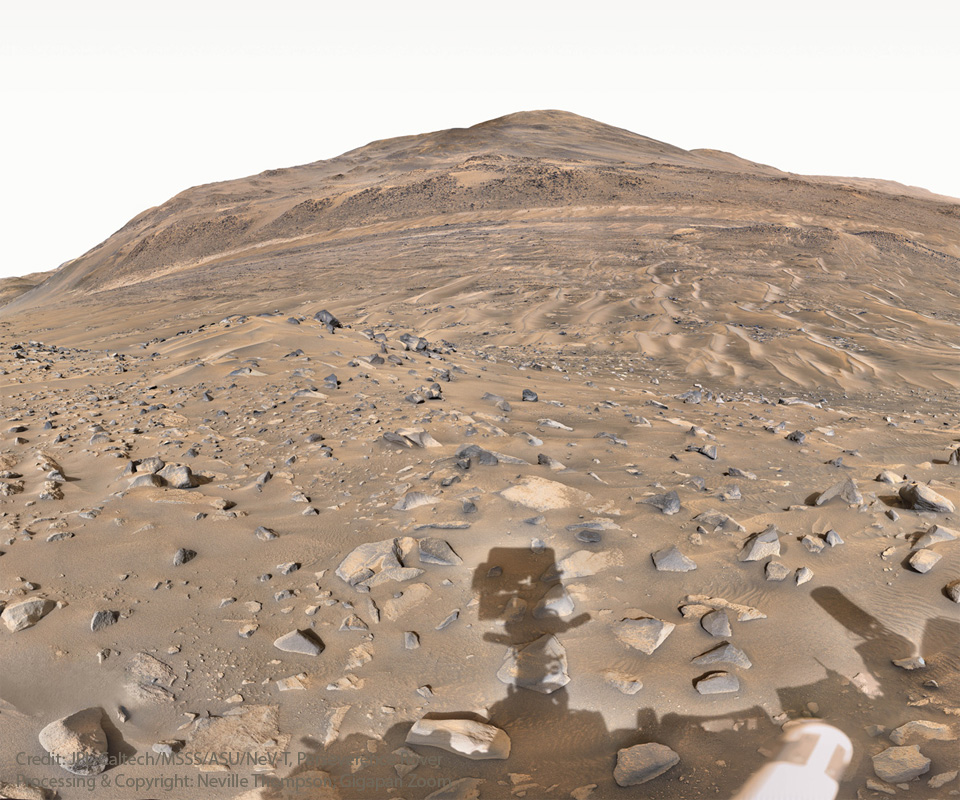
What if you saw your shadow on Mars and it wasn't human? Then you might be the Perseverance rover exploring Mars. Perseverance has been examining the Red Planet since 2021, finding evidence of its complex history of volcanism and ancient flowing water, and sending breathtaking images across the inner Solar System. Pictured here in February of 2024, Perseverance looks opposite the Sun and across Neretva Vallis in Jezero Crater, with a local hill visible at the top of the frame. The distinctively non-human shadow of the car-sized rover is visible below center, superposed on scattered rocks. Perseverance, now working without its flying companion Ingenuity, continues to search Mars for signs of ancient life.