The Sun
The Sun is a yellow dwarf star (G2V), about 4.6 billion years old, and the dominant gravitational force in the Solar System. It has a diameter of roughly 1.4 million kilometers and contains around 99.8% of the Solar System’s mass. Nuclear fusion in its core converts hydrogen into helium, producing energy that warms the planets. Above the core lie the radiative and convective zones, followed by the visible photosphere (~5,500 °C), the chromosphere, and the much hotter corona (~2 million °C).
Source: science.nasa.gov
APODs including "The Sun"
Prominences and Filaments on the Active Sun
15/06/2024
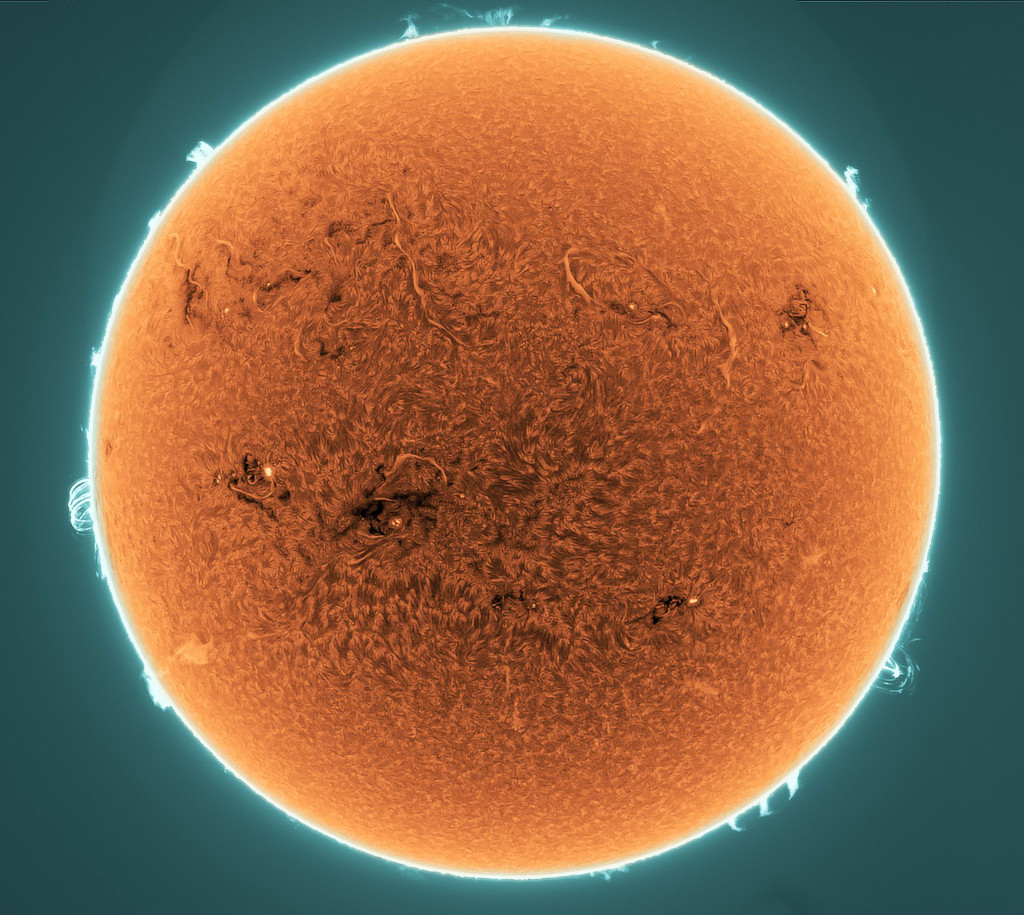
This colorized and digitally sharpened image of the Sun is composed of frames recording emission from hydrogen atoms in the solar chromosphere on May 15. Approaching the maximum of solar cycle 25, a multitude of planet-dwarfing active regions and twisting, snake-like solar filaments are seen to sprawl across the surface of the active Sun. Suspended in the active regions' strong magnetic fields, the filaments of plasma lofted beyond the Sun's edge appear as bright solar prominences. The large prominences seen near 4 o'clock, and just before 9 o'clock around the solar limb are post flare loops from two powerful X-class solar flares that both occurred on that day. In fact, the 4 o'clock prominence is associated with the monster active region AR 3664 just rotating off the Sun's edge.