The Sun
The Sun is a yellow dwarf star (G2V), about 4.6 billion years old, and the dominant gravitational force in the Solar System. It has a diameter of roughly 1.4 million kilometers and contains around 99.8% of the Solar System’s mass. Nuclear fusion in its core converts hydrogen into helium, producing energy that warms the planets. Above the core lie the radiative and convective zones, followed by the visible photosphere (~5,500 °C), the chromosphere, and the much hotter corona (~2 million °C).
Source: science.nasa.gov
APODs including "The Sun"
Comet 13P/Olbers
28/06/2024
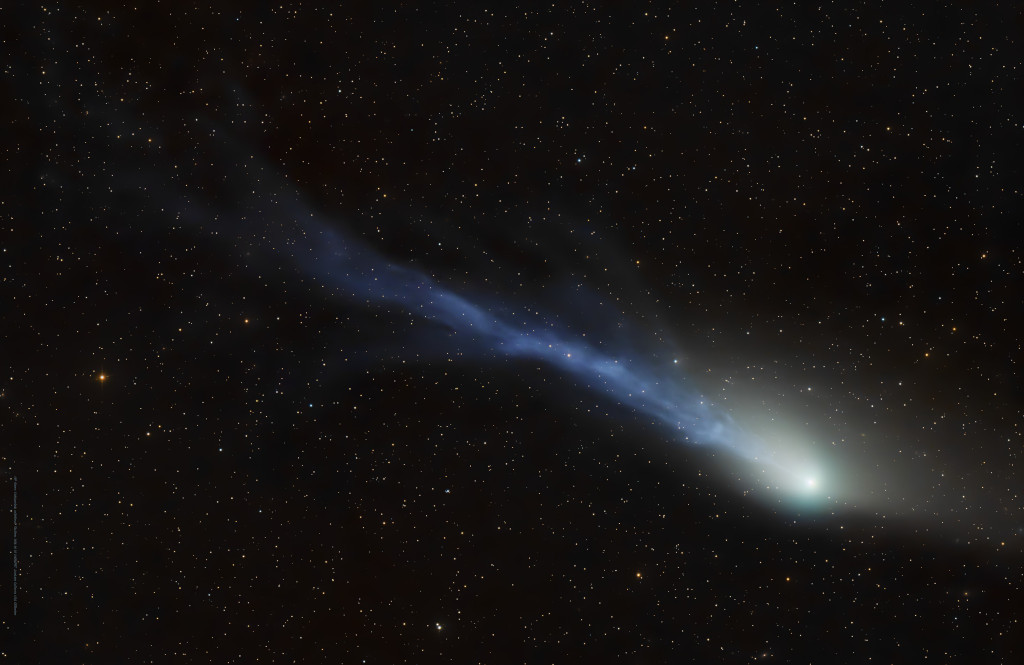
Not a paradox, Comet 13P/Olbers is returning to the inner Solar System after 68 years. The periodic, Halley-type comet will reach its next perihelion or closest approach to the Sun on June 30 and has become a target for binocular viewing low in planet Earth's northern hemisphere night skies. But this sharp telescopic image of 13P is composed of stacked exposures made on the night of June 25. It easily reveals shifting details in the bright comet's torn and tattered ion tail buffeted by the wind from an active Sun, along with a broad, fanned-out dust tail and slightly greenish coma. The frame spans over two degrees across a background of faint stars toward the constellation Lynx.