The Sun
The Sun is a yellow dwarf star (G2V), about 4.6 billion years old, and the dominant gravitational force in the Solar System. It has a diameter of roughly 1.4 million kilometers and contains around 99.8% of the Solar System’s mass. Nuclear fusion in its core converts hydrogen into helium, producing energy that warms the planets. Above the core lie the radiative and convective zones, followed by the visible photosphere (~5,500 °C), the chromosphere, and the much hotter corona (~2 million °C).
Source: science.nasa.gov
APODs including "The Sun"
Noctilucent Clouds over Florida
09/07/2024
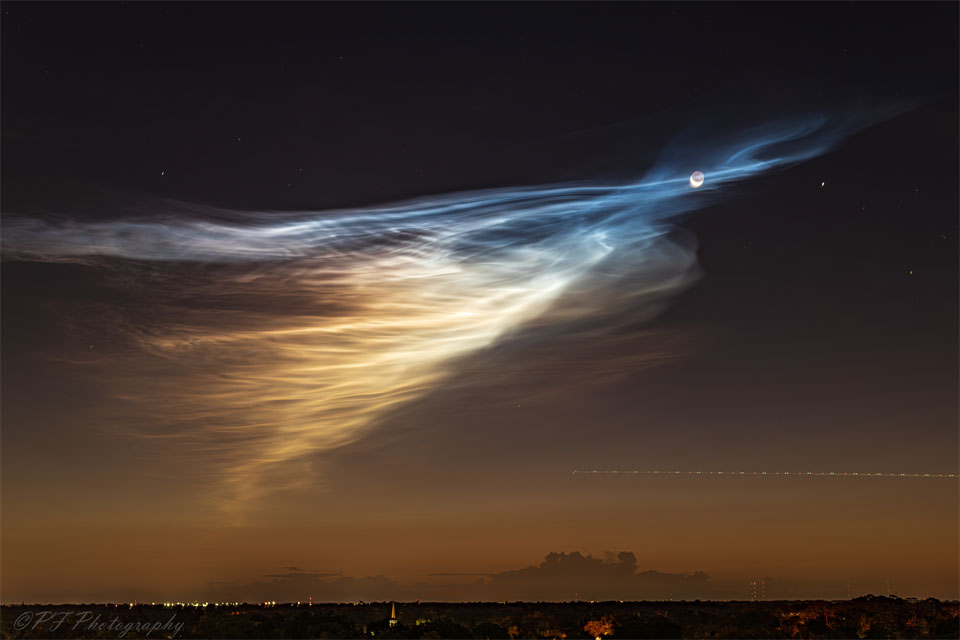
These clouds are doubly unusual. First, they are rare noctilucent clouds, meaning that they are visible at night -- but only just before sunrise or just after sunset. Second, the source of these noctilucent clouds is actually known. In this rare case, the source of the sunlight-reflecting ice-crystals in the upper atmosphere can be traced back to the launch of a nearby SpaceX rocket about 30 minutes earlier. Known more formally as polar mesospheric clouds, the vertex of these icy wisps happens to converge just in front of a rising crescent Moon. The featured image -- and accompanying video -- were captured over Orlando, Florida, USA about a week ago. The bright spot to the right of the Moon is the planet Jupiter, while the dotted lights above the horizon on the right are from an airplane.