The Sun
The Sun is a yellow dwarf star (G2V), about 4.6 billion years old, and the dominant gravitational force in the Solar System. It has a diameter of roughly 1.4 million kilometers and contains around 99.8% of the Solar System’s mass. Nuclear fusion in its core converts hydrogen into helium, producing energy that warms the planets. Above the core lie the radiative and convective zones, followed by the visible photosphere (~5,500 °C), the chromosphere, and the much hotter corona (~2 million °C).
Source: science.nasa.gov
APODs including "The Sun"
Anticrepuscular Rays at the Planet Festival
19/07/2024
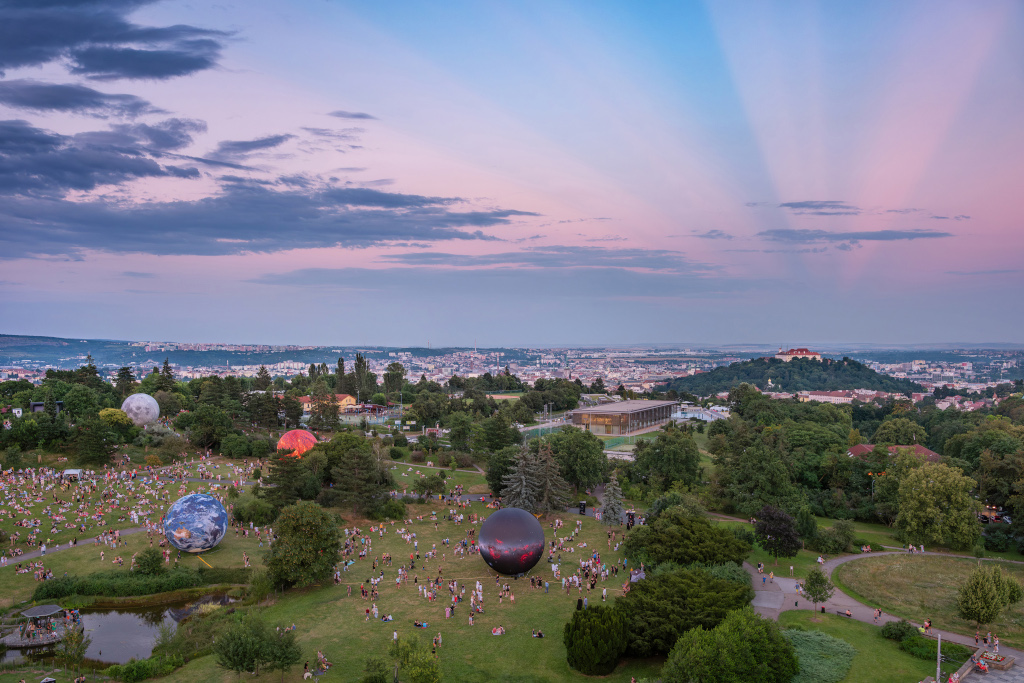
For some, these subtle bands of light and shadow stretched across the sky as the Sun set on July 11. Known as anticrepuscular rays, the bands are formed as a large cloud bank near the western horizon cast long shadows through the atmosphere at sunset. Due to the camera's perspective, the bands of light and shadow seem to converge toward the eastern (opposite) horizon at a point seen just above a 14th century hilltop castle in Brno, Czech Republic. In the foreground, denizens of planet Earth are enjoying the region's annual Planet Festival in the park below the Brno Observatory and Planetarium. And while crepuscular and anticrepuscular rays are a relatively common atmospheric phenomenon, this festival's 10 meter diameter inflatable spheres representing bodies of the Solar System are less often seen on planet Earth.