The Sun
The Sun is a yellow dwarf star (G2V), about 4.6 billion years old, and the dominant gravitational force in the Solar System. It has a diameter of roughly 1.4 million kilometers and contains around 99.8% of the Solar System’s mass. Nuclear fusion in its core converts hydrogen into helium, producing energy that warms the planets. Above the core lie the radiative and convective zones, followed by the visible photosphere (~5,500 °C), the chromosphere, and the much hotter corona (~2 million °C).
Source: science.nasa.gov
APODs including "The Sun"
A Triangular Prominence Hovers Over the Sun
02/09/2024
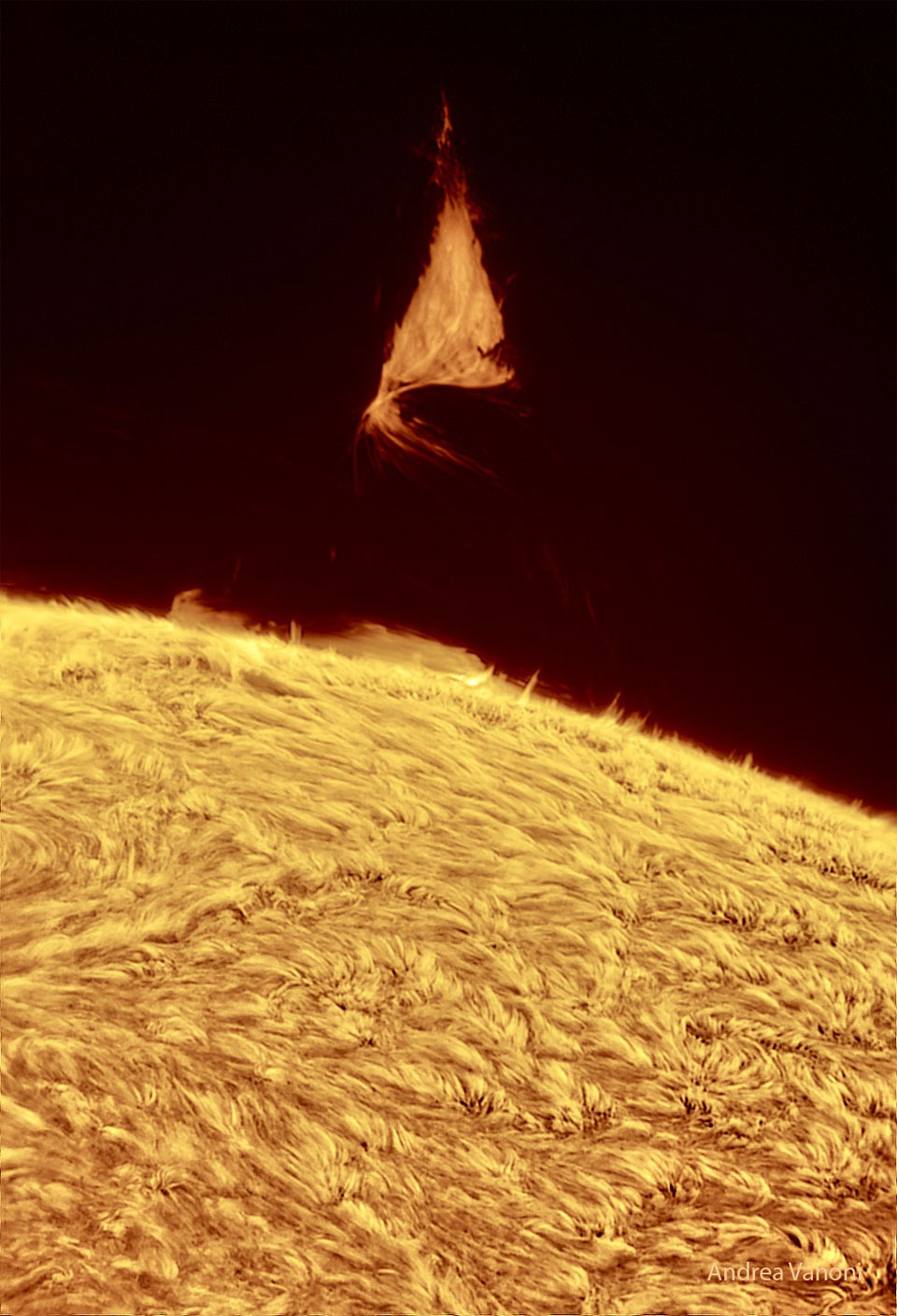
Why is there a triangle hovering over the Sun? Although the shape is unusual, the type of structure is not: it is part of an evolving solar prominence. Looping magnetic fields on the Sun channel the flow of energetic particles, sometimes holding glowing gaseous structures aloft for months. A prominence glows brightly because it contains particularly hot, dense, or opaque solar plasma. The surprising triangular structure occurred last week. Larger than our Earth, the iconic prominence was imaged by several solar photographers and documented by NASA's Solar Dynamic Observatory to form and violently dissipate in about a day. The featured image was captured in a color of red light emitted strongly by hydrogen. Below, solar fibrils carpet the Sun's chromosphere, while the background sky is so faint in comparison that no stars are visible. Our Sun's surface has been quite active this year.