The Sun
The Sun is a yellow dwarf star (G2V), about 4.6 billion years old, and the dominant gravitational force in the Solar System. It has a diameter of roughly 1.4 million kilometers and contains around 99.8% of the Solar System’s mass. Nuclear fusion in its core converts hydrogen into helium, producing energy that warms the planets. Above the core lie the radiative and convective zones, followed by the visible photosphere (~5,500 °C), the chromosphere, and the much hotter corona (~2 million °C).
Source: science.nasa.gov
APODs including "The Sun"
Sunrise Shadows in the Sky
21/09/2024
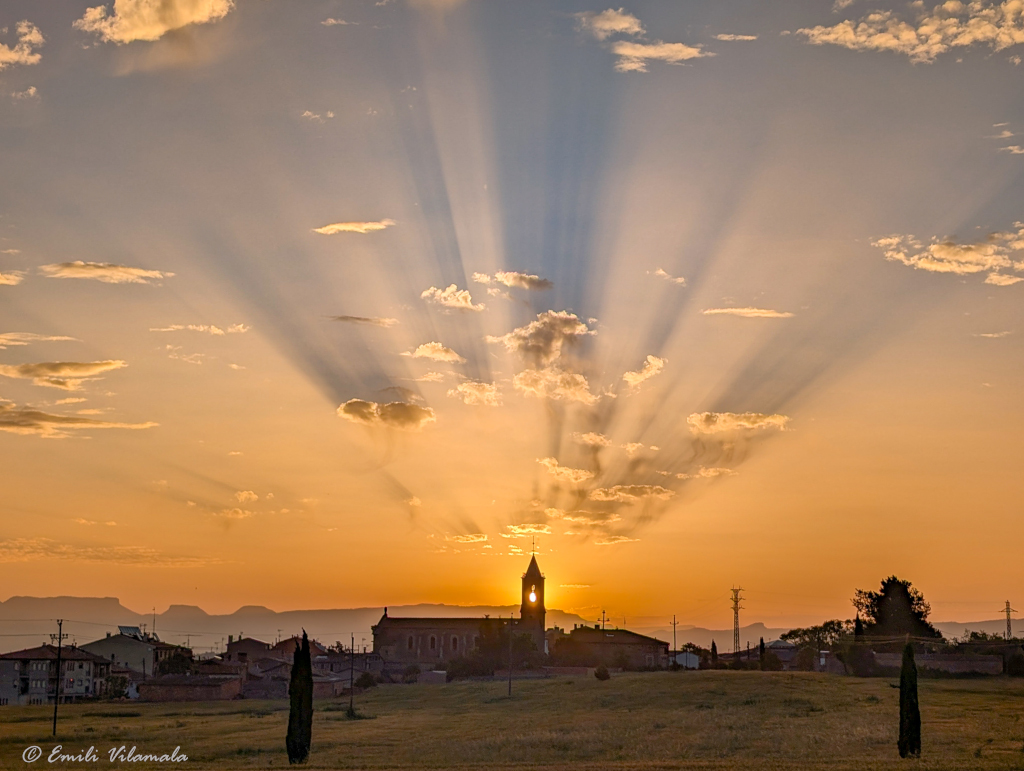
The defining astronomical moment of this September's equinox is at 12:44 UTC on September 22, when the Sun crosses the celestial equator moving south in its yearly journey through planet Earth's sky. That marks the beginning of fall for our fair planet in the northern hemisphere and spring in the southern hemisphere, when day and night are nearly equal around the globe. Of course, if you celebrate the astronomical change of seasons by watching a sunrise you can also look for crepuscular rays. Outlined by shadows cast by clouds, crepuscular rays can have a dramatic appearance in the twilight sky during any sunrise (or sunset). Due to perspective, the parallel cloud shadows will seem to point back to the rising Sun and a place due east on your horizon on the equinox date. But in this spectacular sunrise skyscape captured in early June, the parallel shadows and crepuscular rays appear to converge toward an eastern horizon's more northerly sunrise. The well-composed photo places the rising Sun just behind the bell tower of a church in the town of Vic, province of Barcelona, Catalonia, Spain.