The Sun
The Sun is a yellow dwarf star (G2V), about 4.6 billion years old, and the dominant gravitational force in the Solar System. It has a diameter of roughly 1.4 million kilometers and contains around 99.8% of the Solar System’s mass. Nuclear fusion in its core converts hydrogen into helium, producing energy that warms the planets. Above the core lie the radiative and convective zones, followed by the visible photosphere (~5,500 °C), the chromosphere, and the much hotter corona (~2 million °C).
Source: science.nasa.gov
APODs including "The Sun"
Comet Tsuchinshan-ATLAS Approaches
23/09/2024
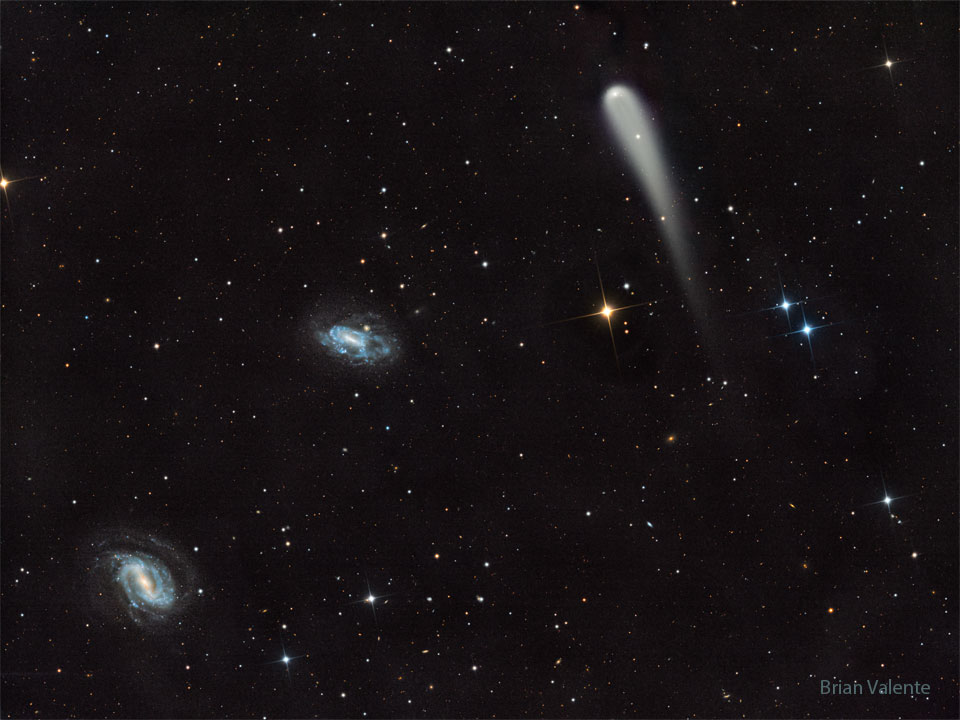
What will happen as this already bright comet approaches? Optimistic predictions have Comet C/2023 A3 (Tsuchinshan–ATLAS) briefly becoming easily visible to the unaided eye -- although the future brightness of comets are notoriously hard to predict, and this comet may even break up in warming sunlight. What is certain is that the comet is now unexpectedly bright and is on track to pass its closest to the Sun (0.39 AU) later this week and closest to the Earth (0.47 AU) early next month. The featured image was taken in late May as Comet Tsuchinshan–ATLAS, discovered only last year, passed nearly in front of two distant galaxies. The comet can now be found with binoculars in the early morning sky rising just before the Sun, while over the next few weeks it will brighten as it moves to the early evening sky. Your Sky Surprise: What picture did APOD feature on your birthday? (post 1995)