The Sun
The Sun is a yellow dwarf star (G2V), about 4.6 billion years old, and the dominant gravitational force in the Solar System. It has a diameter of roughly 1.4 million kilometers and contains around 99.8% of the Solar System’s mass. Nuclear fusion in its core converts hydrogen into helium, producing energy that warms the planets. Above the core lie the radiative and convective zones, followed by the visible photosphere (~5,500 °C), the chromosphere, and the much hotter corona (~2 million °C).
Source: science.nasa.gov
APODs including "The Sun"
Comet Tsuchinshan-ATLAS over Mexico
30/09/2024
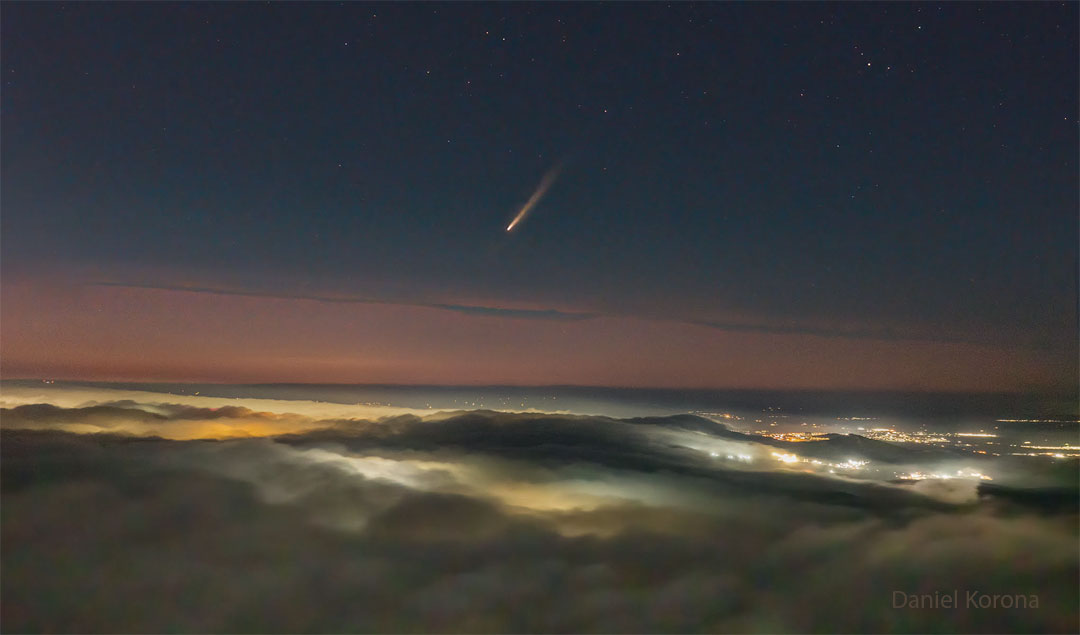
The new comet has passed its closest to the Sun and is now moving closer to the Earth. C/2023 A3 (Tsuchinshan–ATLAS) is currently moving out from inside the orbit of Venus and on track to pass its nearest to the Earth in about two weeks. Comet Tsuchinshan-ATLAS, pronounced "Choo-cheen-shahn At-less,", is near naked-eye visibility and easily picked up by long-exposure cameras. The comet can also now be found by observers in Earth's northern hemisphere as well as the south. The featured image was captured just a few days ago above Zacatecas, Mexico. Because clouds were obscuring much of the pre-dawn sky, the astrophotographer released a drone to take pictures from higher up, several of which were later merged to enhance the comet's visibility. Although the future brightness of comets is hard to predict, there is increasing hope that Comet Tsuchinshan-ATLAS will further brighten as it enters the early evening sky. Growing Gallery: Comet Tsuchinsan-ATLAS in 2024