The Sun
The Sun is a yellow dwarf star (G2V), about 4.6 billion years old, and the dominant gravitational force in the Solar System. It has a diameter of roughly 1.4 million kilometers and contains around 99.8% of the Solar System’s mass. Nuclear fusion in its core converts hydrogen into helium, producing energy that warms the planets. Above the core lie the radiative and convective zones, followed by the visible photosphere (~5,500 °C), the chromosphere, and the much hotter corona (~2 million °C).
Source: science.nasa.gov
APODs including "The Sun"
Eclipse at Sunrise
03/10/2024
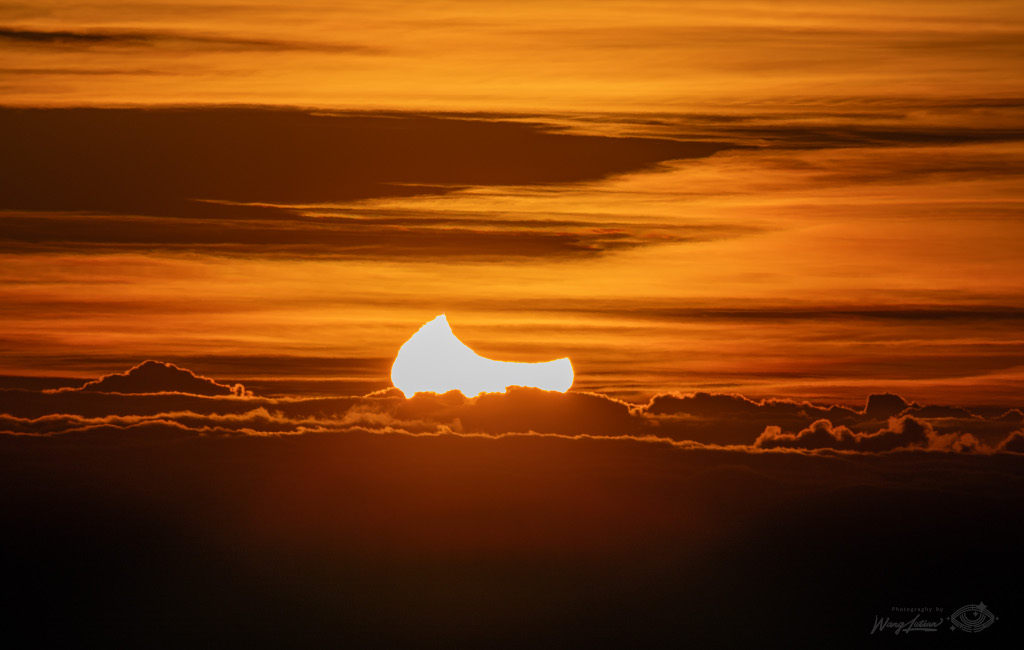
The second solar eclipse of 2024 began in the Pacific. On October 2nd the Moon's shadow swept from west to east, with an annular eclipse visible along a narrow antumbral shadow path tracking mostly over ocean, crossing land near the southern tip of South America, and ending in the southern Atlantic. The dramatic total annular eclipse phase is known to some as a ring of fire. Still, a partial eclipse of the Sun was experienced over a wide region. Captured at one of its earliest moments, October's eclipsed Sun is seen just above the clouds near sunrise in this snapshot. The partially eclipsed solar disk is close to the maximum eclipse as seen from Mauna Kea Observatory Visitor Center, Island of Hawaii, planet Earth. Growing Gallery: Annular Solar Eclipse 2024 October