The Sun
The Sun is a yellow dwarf star (G2V), about 4.6 billion years old, and the dominant gravitational force in the Solar System. It has a diameter of roughly 1.4 million kilometers and contains around 99.8% of the Solar System’s mass. Nuclear fusion in its core converts hydrogen into helium, producing energy that warms the planets. Above the core lie the radiative and convective zones, followed by the visible photosphere (~5,500 °C), the chromosphere, and the much hotter corona (~2 million °C).
Source: science.nasa.gov
APODs including "The Sun"
Comet at Moonrise
04/10/2024
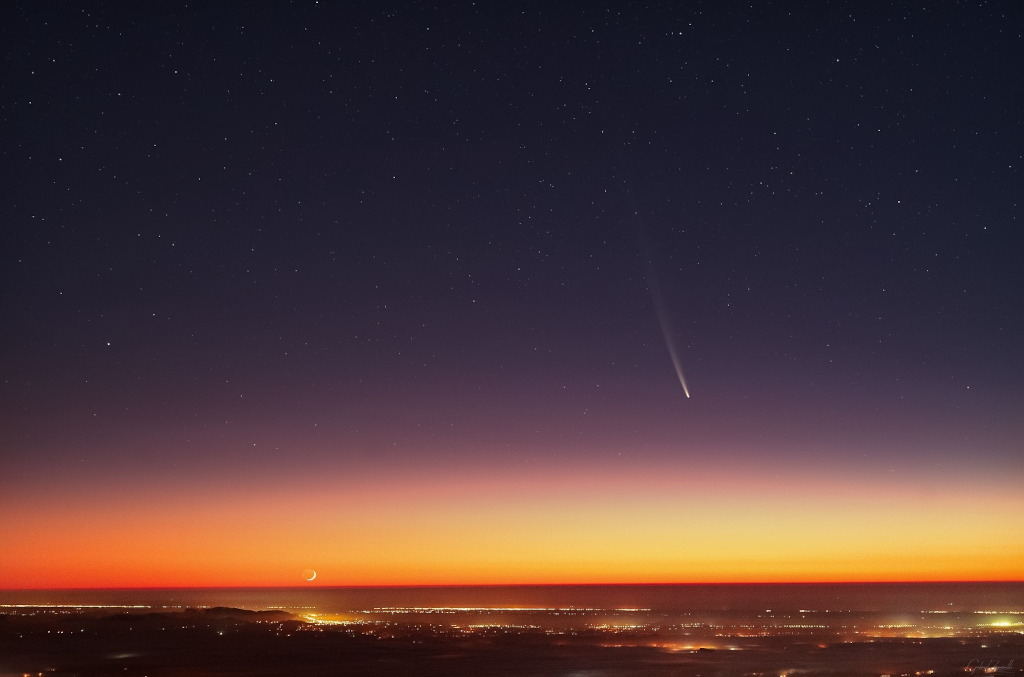
Comet C/2023 A3 (Tsuchinshan–ATLAS) is growing brighter in planet Earth's sky. Fondly known as comet A3, this new visitor to the inner Solar System is traveling from the distant Oort cloud. The comet reached perihelion, its closest approach to the Sun, on September 27 and will reach perigee, its closest to our fair planet, on October 12, by then becoming an evening sky apparition. But comet A3 was an early morning riser on September 30 when this image was made. Its bright coma and already long tail share a pre-dawn skyscape from Praia Grande, Santa Catarina in southern Brazil with the waning crescent Moon just peeking above the eastern horizon. While the behaviour of comets is notoriously unpredictable, Tsuchinshan–ATLAS could become a comet visually rivaling C/2020 F3 (NEOWISE). Comet NEOWISE wowed skygazers in the summer of 2020. Growing Gallery: Comet Tsuchinsan-ATLAS in 2024