The Sun
The Sun is a yellow dwarf star (G2V), about 4.6 billion years old, and the dominant gravitational force in the Solar System. It has a diameter of roughly 1.4 million kilometers and contains around 99.8% of the Solar System’s mass. Nuclear fusion in its core converts hydrogen into helium, producing energy that warms the planets. Above the core lie the radiative and convective zones, followed by the visible photosphere (~5,500 °C), the chromosphere, and the much hotter corona (~2 million °C).
Source: science.nasa.gov
APODs including "The Sun"
The Long Tails Comet Tsuchinshan-ATLAS
07/10/2024
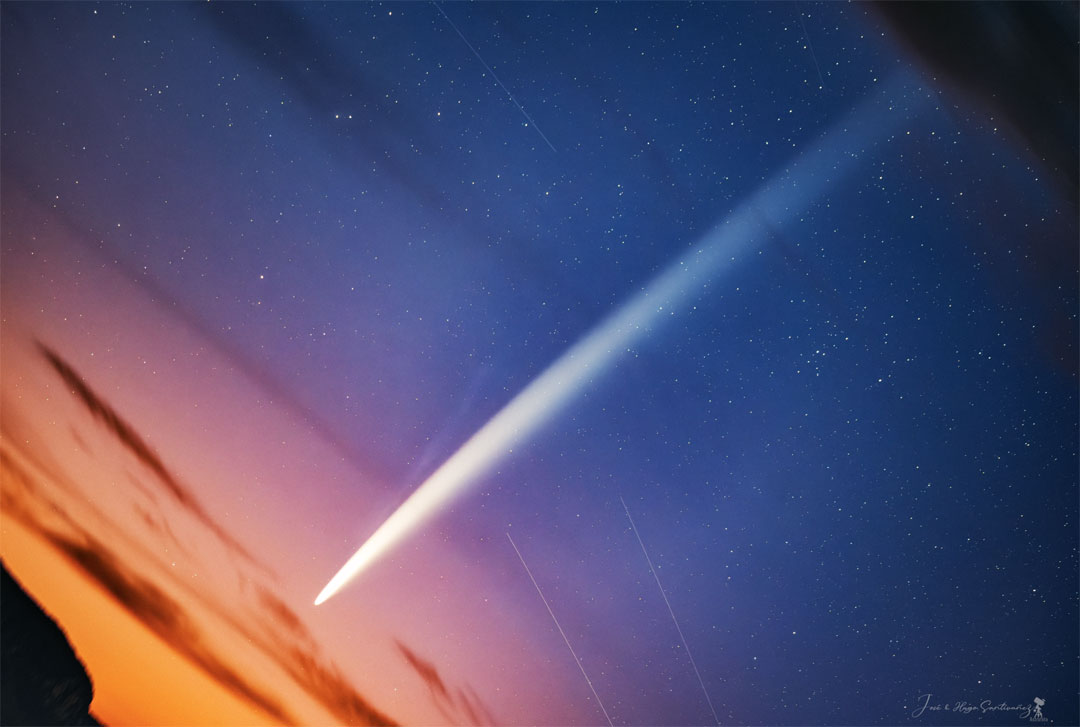
A bright comet is moving into the evening skies. C/2023 A3 (Tsuchinshan–ATLAS) has brightened and even though it is now easily visible to the unaided eye, it is so near to the Sun that it is still difficult to see. Pictured, Comet Tsuchinshan–ATLAS was captured just before sunrise from an Andes Mountain in Peru. Braving cold weather, this unusually high perch gave the astrophotographer such a low eastern horizon that the comet was obvious in the pre-dawn sky. Visible in the featured image is not only an impressively long dust tail extending over many degrees, but an impressively long and blue ion tail, too. This month, as the comet moves out from the Sun and passes the Earth, evening observers should be able to see the huge dirty ice ball toward the west just after sunset. Growing Gallery: Comet Tsuchinsan-ATLAS in 2024