The Sun
The Sun is a yellow dwarf star (G2V), about 4.6 billion years old, and the dominant gravitational force in the Solar System. It has a diameter of roughly 1.4 million kilometers and contains around 99.8% of the Solar System’s mass. Nuclear fusion in its core converts hydrogen into helium, producing energy that warms the planets. Above the core lie the radiative and convective zones, followed by the visible photosphere (~5,500 °C), the chromosphere, and the much hotter corona (~2 million °C).
Source: science.nasa.gov
APODs including "The Sun"
Five Bright Comets from SOHO
10/10/2024
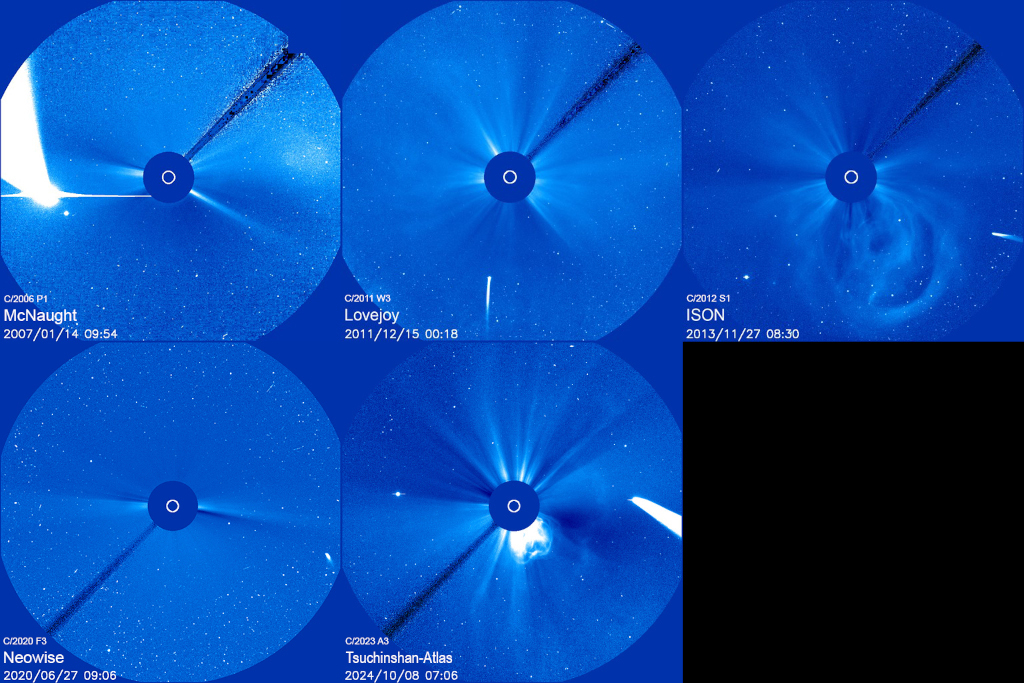
Five bright comets are compared in these panels, recorded by a coronograph on board the long-lived, sun-staring SOHO spacecraft. Arranged chronologically all are recognizable by their tails streaming away from the Sun at the center of each field of view, where a direct view of the overwhelmingly bright Sun is blocked by the coronagraph's occulting disk. Each comet was memorable for earthbound skygazers, starting at top left with Comet McNaught, the 21st century's brightest comet (so far). C/2023 A3 Tsuchinshan-ATLAS, following its perihelion with the active Sun at bottom center, has most recently grabbed the attention of comet watchers around the globe. By the end of October 2024, the blank 6th panel may be filled with bright sungrazer comet C/2024 S1 (ATLAS). ... or not.