The Sun
The Sun is a yellow dwarf star (G2V), about 4.6 billion years old, and the dominant gravitational force in the Solar System. It has a diameter of roughly 1.4 million kilometers and contains around 99.8% of the Solar System’s mass. Nuclear fusion in its core converts hydrogen into helium, producing energy that warms the planets. Above the core lie the radiative and convective zones, followed by the visible photosphere (~5,500 °C), the chromosphere, and the much hotter corona (~2 million °C).
Source: science.nasa.gov
APODs including "The Sun"
Comet Tsuchinshan-ATLAS over California
21/10/2024
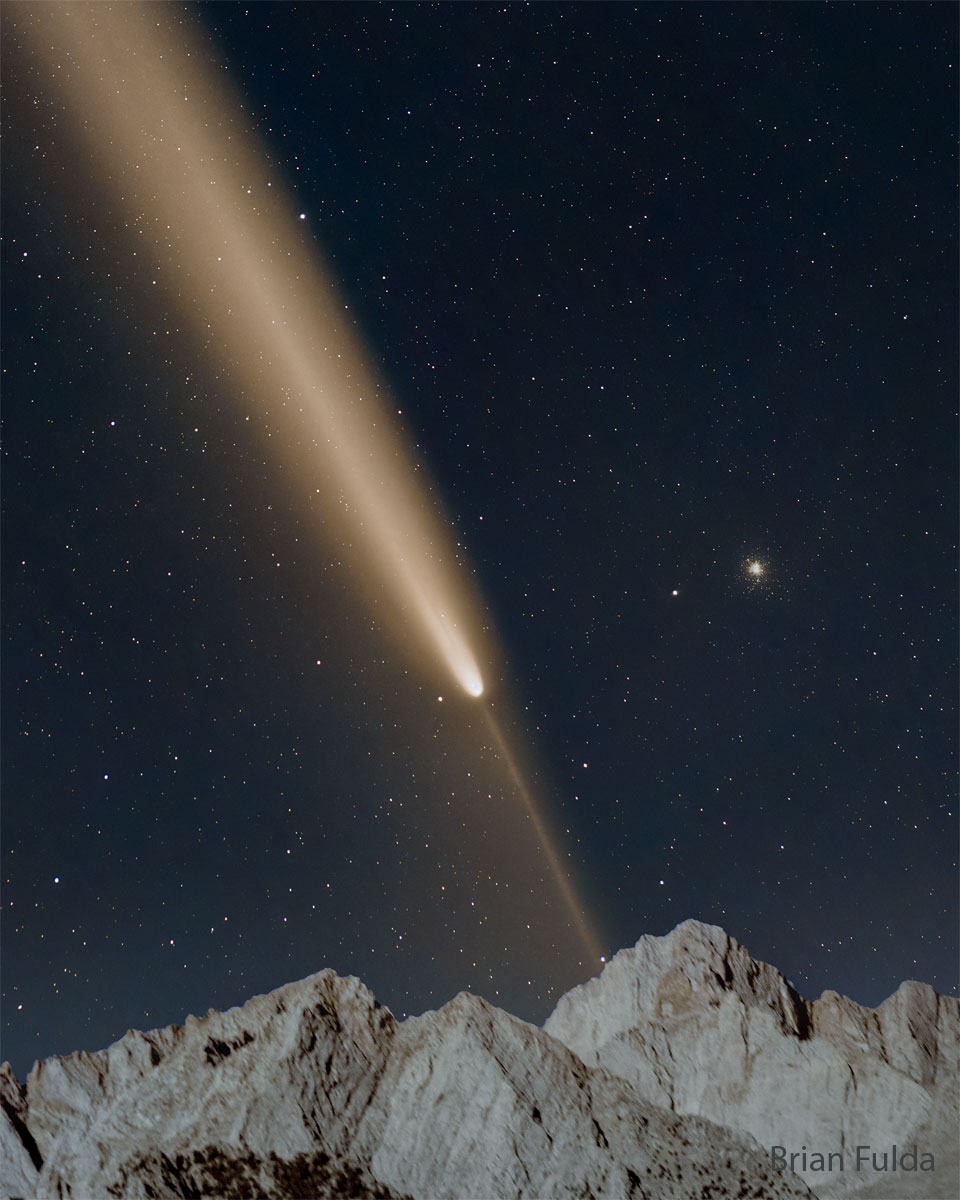
The tails of Comet Tsuchinshan-ATLAS were a sight to behold. Pictured, C/2023 A3 (Tsuchinshan–ATLAS) was captured near peak impressiveness last week over the Eastern Sierra Mountains in California, USA. The comet not only showed a bright tail, but a distinct anti-tail pointing in nearly the opposite direction. The globular star cluster M5 can be seen on the right, far in the distance. As it approached, it was unclear if this crumbling iceberg would disintegrate completely as it warmed in the bright sunlight. In reality, the comet survived to become brighter than any star in the night (magnitude -4.9), but unfortunately was then so nearly in front of the Sun that it was hard for many casual observers to locate. Whether Comet Tsuchinshan-Atlas becomes known as the Great Comet of 2024 now depends, in part, on how impressive incoming comet C/2024 S1 (ATLAS) becomes over the next two weeks. Your Sky Surprise: What picture did APOD feature on your birthday? (post 1995)