The Sun
The Sun is a yellow dwarf star (G2V), about 4.6 billion years old, and the dominant gravitational force in the Solar System. It has a diameter of roughly 1.4 million kilometers and contains around 99.8% of the Solar System’s mass. Nuclear fusion in its core converts hydrogen into helium, producing energy that warms the planets. Above the core lie the radiative and convective zones, followed by the visible photosphere (~5,500 °C), the chromosphere, and the much hotter corona (~2 million °C).
Source: science.nasa.gov
APODs including "The Sun"
Comet Tsuchinshan-Atlas over the Dolomites
06/11/2024
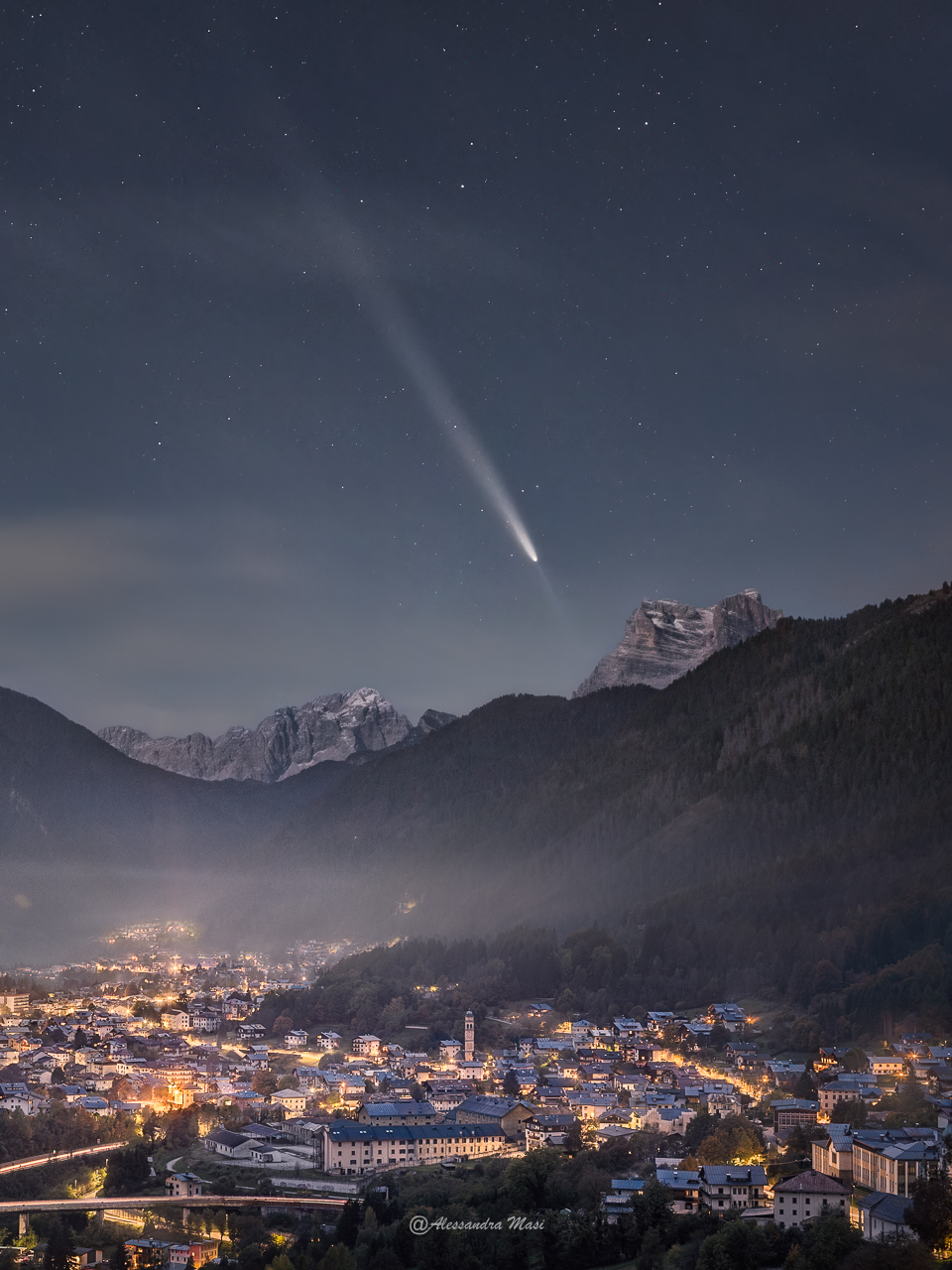
Comet Tsuchinshan-Atlas is now headed back to the outer Solar System. The massive dusty snowball put on quite a show during its trip near the Sun, resulting in many impressive pictures from planet Earth during October. The featured image was taken in mid-October and shows a defining visual feature of the comet -- its impressive anti-tail. The image captures Comet C/2023 A3 (Tsuchinshan–ATLAS) with impressively long dust and ion tails pointing up and away from the Sun, while the strong anti-tail -- composed of more massive dust particles -- trails the comet and points down and (nearly) toward the recently-set Sun. In the foreground is village of Tai di Cadore, Italy, with the tremendous Dolomite Mountains in the background. Another comet, C/2024 S1 (ATLAS), once a candidate to rival Comet Tsuchinshan-Atlas in brightness, broke up last week during its close approach to our Sun. Growing Gallery: Comet Tsuchinshan-ATLAS in 2024