The Sun
The Sun is a yellow dwarf star (G2V), about 4.6 billion years old, and the dominant gravitational force in the Solar System. It has a diameter of roughly 1.4 million kilometers and contains around 99.8% of the Solar System’s mass. Nuclear fusion in its core converts hydrogen into helium, producing energy that warms the planets. Above the core lie the radiative and convective zones, followed by the visible photosphere (~5,500 °C), the chromosphere, and the much hotter corona (~2 million °C).
Source: science.nasa.gov
APODs including "The Sun"
Alpha Centauri: The Closest Star System
01/01/2025
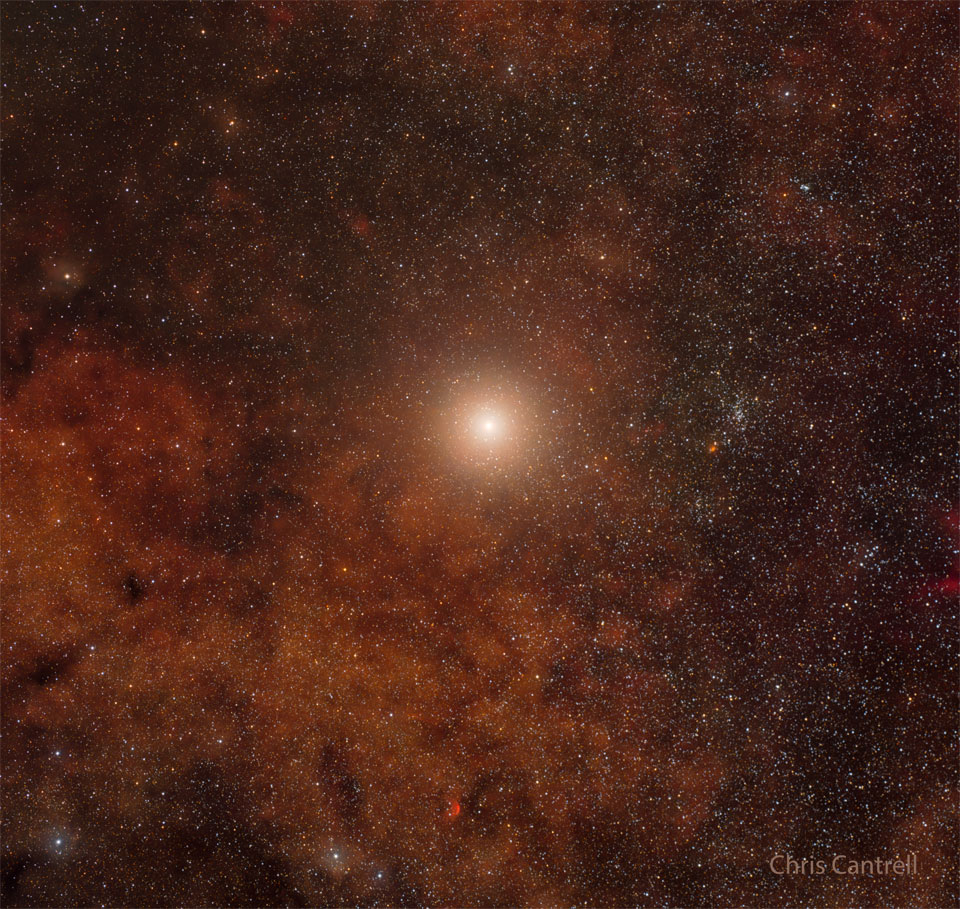
The closest star system to the Sun is the Alpha Centauri system. Of the three stars in the system, the dimmest -- called Proxima Centauri -- is actually the nearest star. The bright stars Alpha Centauri A and B form a close binary as they are separated by only 23 times the Earth- Sun distance - slightly greater than the distance between Uranus and the Sun. The Alphasystem is not visible in much of the northern hemisphere. Alpha Centauri A, also known as Rigil Kentaurus, is the brightest star in the constellation of Centaurus and is the fourth brightest star in the night sky. Sirius is the brightest even though it is more than twice as far away. By an exciting coincidence, Alpha Centauri A is the same type of star as our Sun, and Proxima Centauri is now known to have a potentially habitable exoplanet.