The Sun
The Sun is a yellow dwarf star (G2V), about 4.6 billion years old, and the dominant gravitational force in the Solar System. It has a diameter of roughly 1.4 million kilometers and contains around 99.8% of the Solar System’s mass. Nuclear fusion in its core converts hydrogen into helium, producing energy that warms the planets. Above the core lie the radiative and convective zones, followed by the visible photosphere (~5,500 °C), the chromosphere, and the much hotter corona (~2 million °C).
Source: science.nasa.gov
APODs including "The Sun"
Welcome to Perihelion
04/01/2025
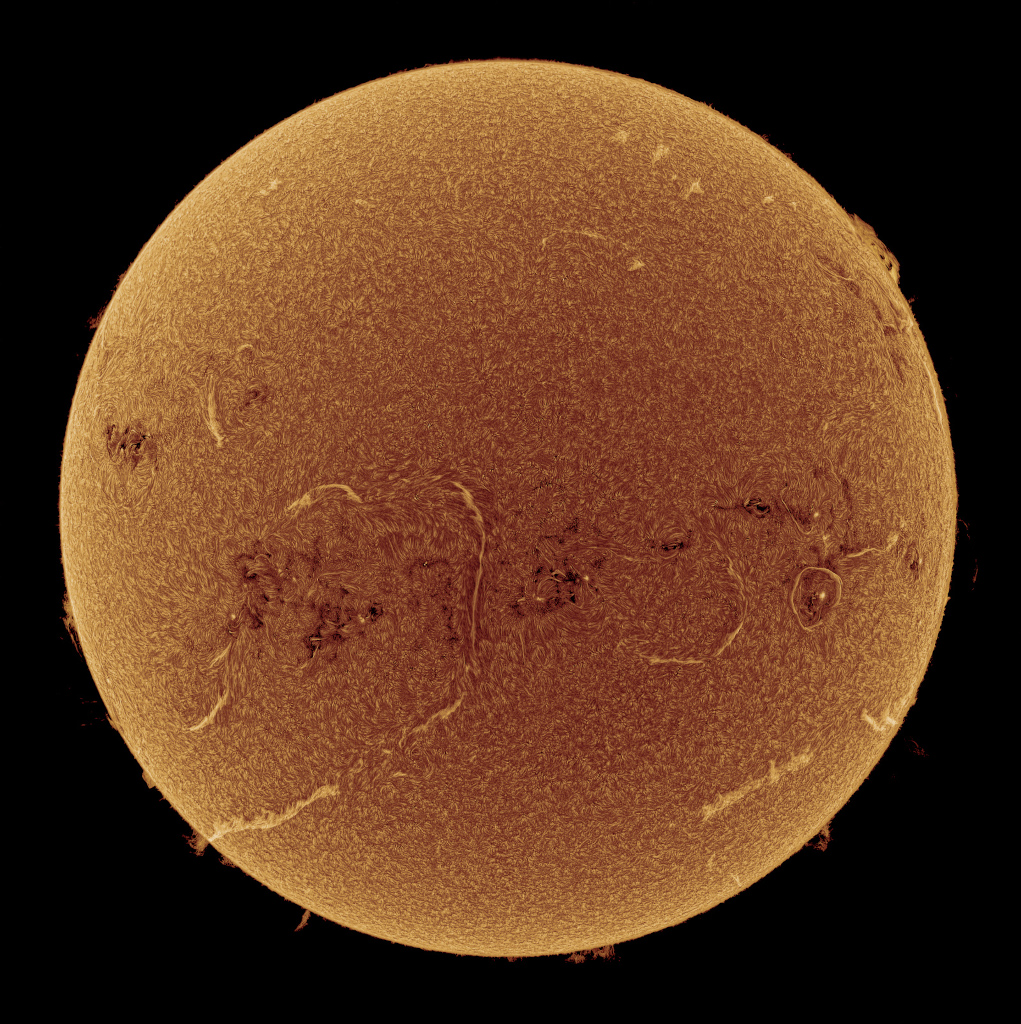
rth's orbit around the Sun is not a circle, it's an ellipse. The point along its elliptical orbit where our fair planet is closest to the Sun is called perihelion. This year perihelion is today, January 4, at 13:28 UTC, only a few hours before this H-alpha picture of the active Sun was taken. At perihelion the Earth was about 147 million kilometers from the Sun. For comparison, at aphelion on last July 3 Earth was at its farthest distance from the Sun, some 152 million kilometers away. But distance from the Sun doesn't determine Earth's seasons. It's only by coincidence that the beginning of southern summer (northern winter) on the December solstice is within 14 days of Earth's perihelion date. And it's only by coincidence that Earth's perihelion date is within 11 days of the historic perihelion of NASA's Parker Solar Probe. Launched in 2018, the Parker Solar Probe flew within 6.2 million kilometers of the Sun's surface on 2024 December 24, breaking its own record for closest perihelion for a spacecraft from planet Earth.