The Sun
The Sun is a yellow dwarf star (G2V), about 4.6 billion years old, and the dominant gravitational force in the Solar System. It has a diameter of roughly 1.4 million kilometers and contains around 99.8% of the Solar System’s mass. Nuclear fusion in its core converts hydrogen into helium, producing energy that warms the planets. Above the core lie the radiative and convective zones, followed by the visible photosphere (~5,500 °C), the chromosphere, and the much hotter corona (~2 million °C).
Source: science.nasa.gov
APODs including "The Sun"
Parhelia at Abisko
15/02/2025
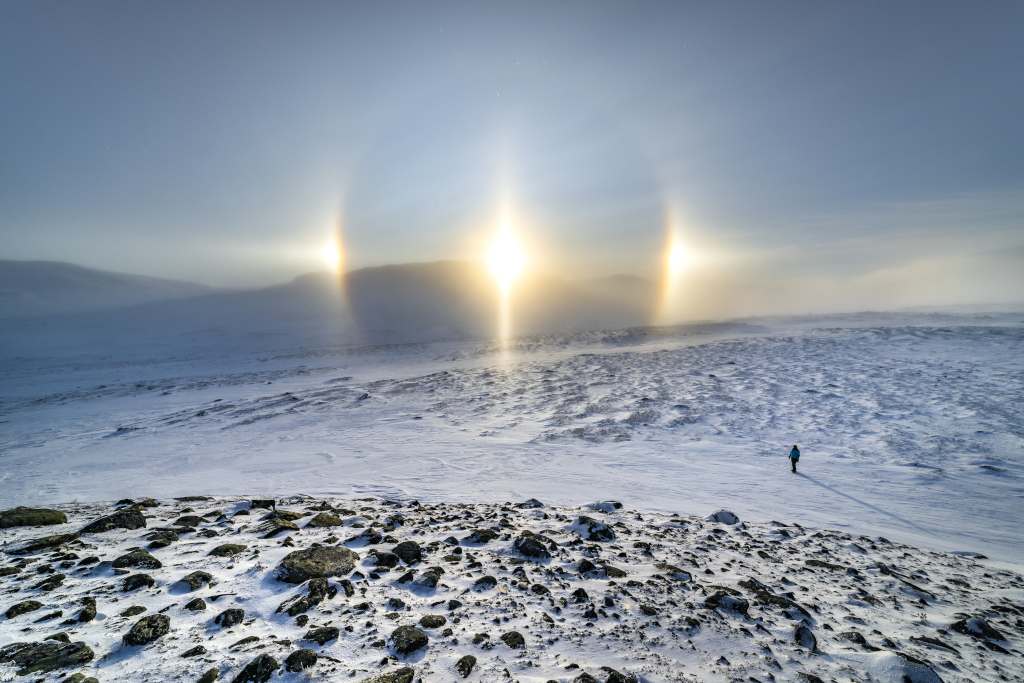
Three suns seem to hug the horizon in this otherworldly winterscape. But the evocative scene was captured during a February 3rd snowmobile exploration of the mountainous region around Abisko National Park, northern Sweden, planet Earth. The two bright spots on either side of Earth's Sun are parhelia (singular parhelion), also known as mock suns or sun dogs. The parhelia are caused by hexagonal ice crystals suspended in the hazy atmosphere that reflect and refract sunlight. Commonly seen in winter and at high latitudes, the bright parhelia lie along the visible 22 degree ice halo of the Sun.