The Sun
The Sun is a yellow dwarf star (G2V), about 4.6 billion years old, and the dominant gravitational force in the Solar System. It has a diameter of roughly 1.4 million kilometers and contains around 99.8% of the Solar System’s mass. Nuclear fusion in its core converts hydrogen into helium, producing energy that warms the planets. Above the core lie the radiative and convective zones, followed by the visible photosphere (~5,500 °C), the chromosphere, and the much hotter corona (~2 million °C).
Source: science.nasa.gov
APODs including "The Sun"
Blue Ghost on the Moon
03/03/2025
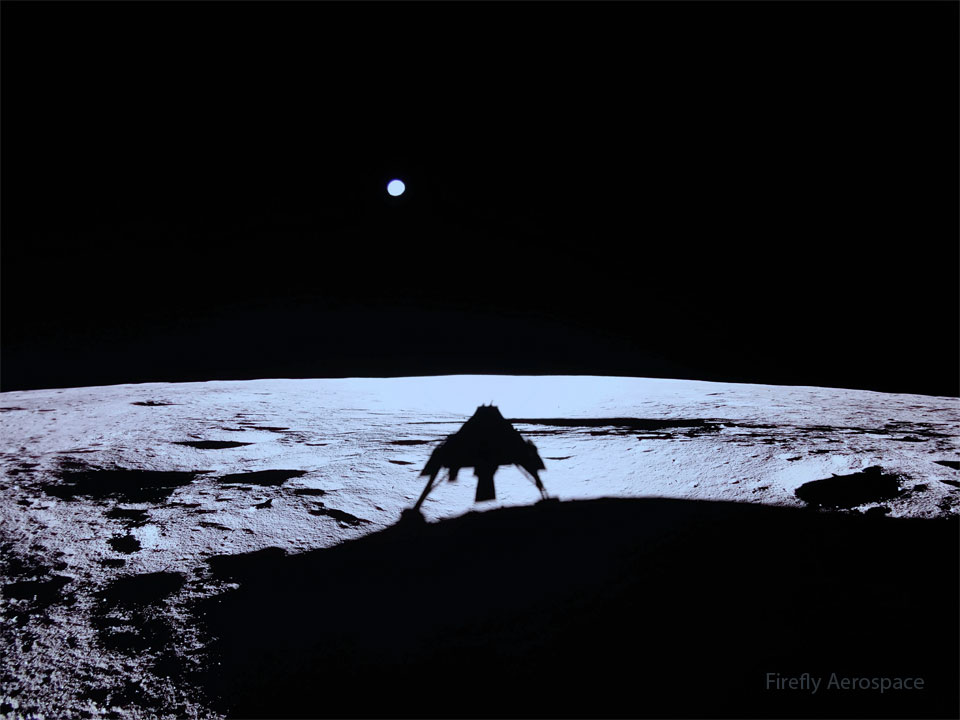
There's a new lander on the Moon. Yesterday Firefly Aerospace's Blue Ghost executed the first-ever successful commercial lunar landing. During its planned 60-day mission, Blue Ghost will deploy several NASA-commissioned scientific instruments, including PlanetVac which captures lunar dust after creating a small whirlwind of gas. Blue Ghost will also host the telescope LEXI that captures X-ray images of the Earth's magnetosphere. LEXI data should enable a better understanding of how Earth's magnetic field protects the Earth from the Sun's wind and flares. Pictured, the shadow of the Blue Ghost lander is visible on the cratered lunar surface, while the glowing orb of the planet Earth hovers just over the horizon. Goals for future robotic Blue Ghost landers include supporting lunar astronauts in NASA's Artemis program, with Artemis III currently scheduled to land humans back on the Moon in 2027.