The Sun
The Sun is a yellow dwarf star (G2V), about 4.6 billion years old, and the dominant gravitational force in the Solar System. It has a diameter of roughly 1.4 million kilometers and contains around 99.8% of the Solar System’s mass. Nuclear fusion in its core converts hydrogen into helium, producing energy that warms the planets. Above the core lie the radiative and convective zones, followed by the visible photosphere (~5,500 °C), the chromosphere, and the much hotter corona (~2 million °C).
Source: science.nasa.gov
APODs including "The Sun"
Blue Ghost's Diamond Ring
19/03/2025
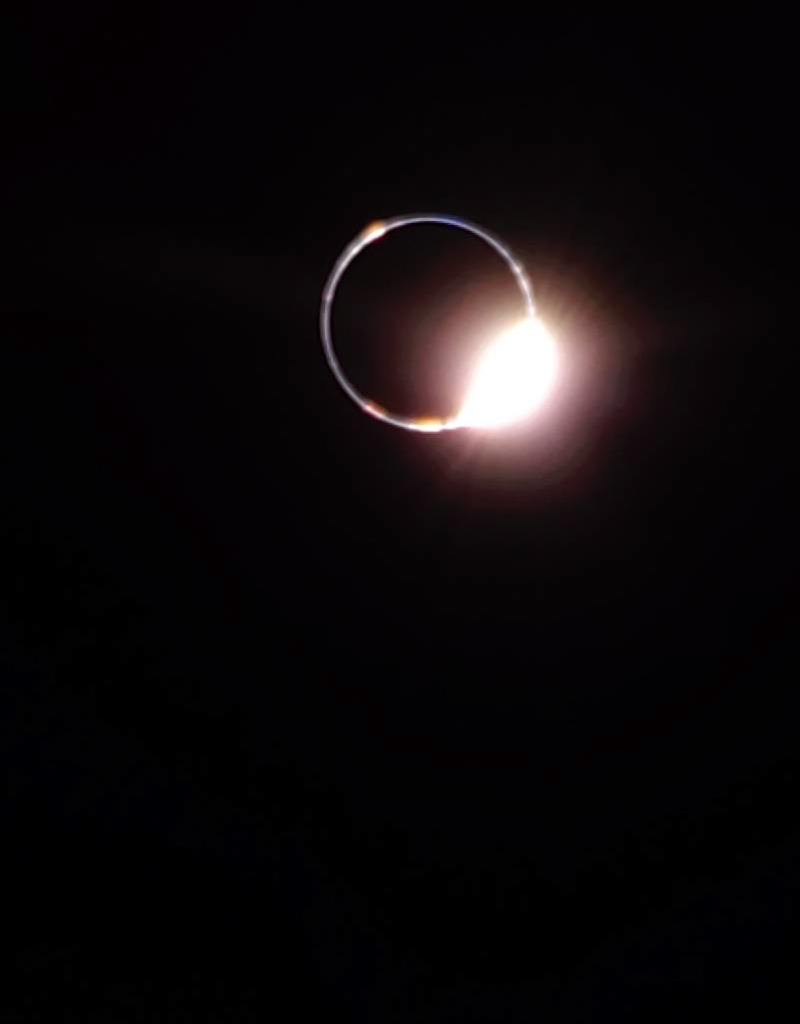
On March 14 the Full Moon slid through Earth's dark umbral shadow and denizens of planet Earth were treated to a total lunar eclipse. Of course, from the Moon's near side that same astronomical syzygy was seen as a solar eclipse. Operating in the Mare Crisium on the lunar surface, the Blue Ghost lander captured this video frame of Earth in silhouette around 3:30am CDT, just as the Sun was emerging from behind the terrestrial disk. From Blue Ghost's lunar perspective the beautiful diamond ring effect, familiar to earthbound solar eclipse watchers, is striking. Since Earth appears about four times the apparent size of the Sun from the lunar surface the inner solar corona, the atmosphere of the Sun most easily seen from Earth during a total solar eclipse, is hidden from view. Still, scattering in Earth's dense atmosphere creates the glowing band of sunlight embracing our fair planet.