The Sun
The Sun is a yellow dwarf star (G2V), about 4.6 billion years old, and the dominant gravitational force in the Solar System. It has a diameter of roughly 1.4 million kilometers and contains around 99.8% of the Solar System’s mass. Nuclear fusion in its core converts hydrogen into helium, producing energy that warms the planets. Above the core lie the radiative and convective zones, followed by the visible photosphere (~5,500 °C), the chromosphere, and the much hotter corona (~2 million °C).
Source: science.nasa.gov
APODs including "The Sun"
A Rocket in the Sun
27/09/2025
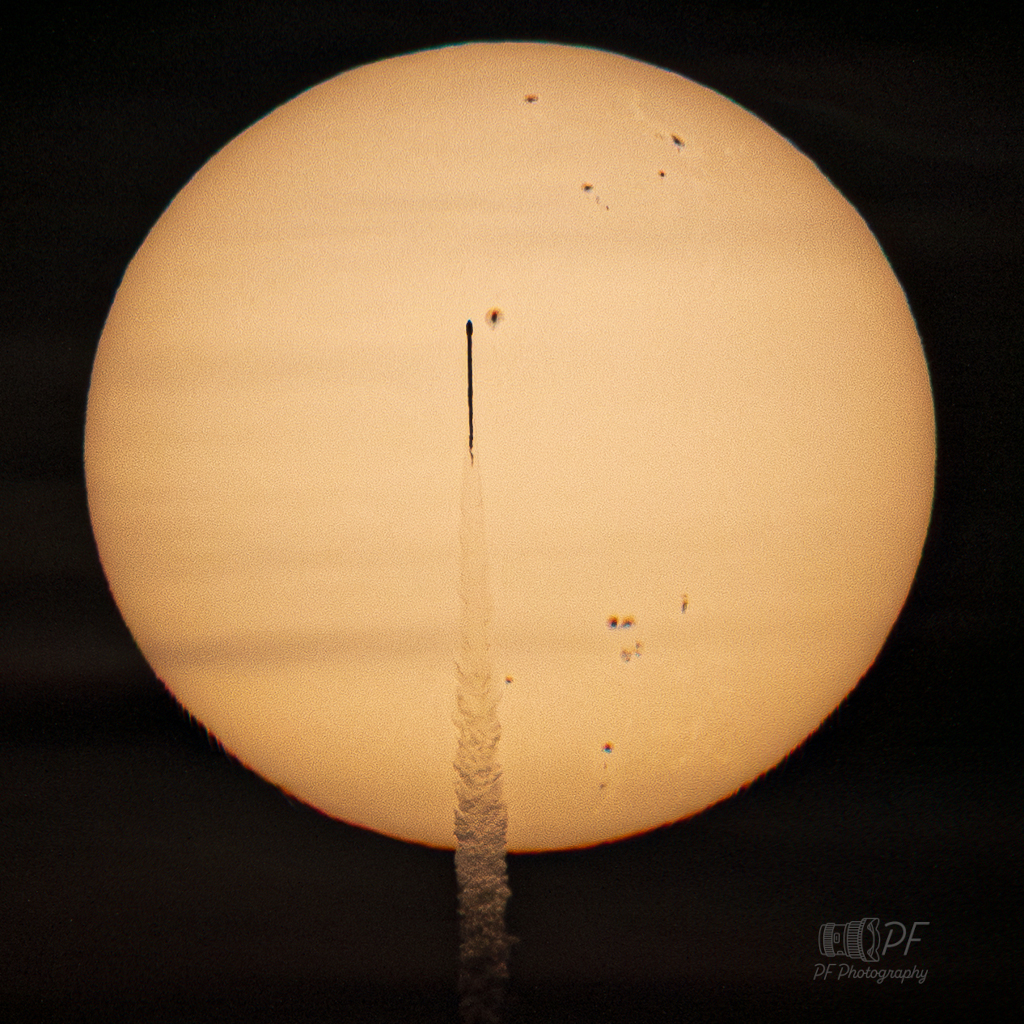
On the morning of September 24 a rocket crosses the bright solar disk in this long range telescopic snapshot captured from Orlando, Florida. That's about 50 miles west of its Kennedy Space Center launch site. This rocket carried three new space weather missions to space. Signals have now been successfully acquired from all three - NASA's Interstellar Mapping and Acceleration Probe, NASA’s Carruthers Geocorona Observatory, and the National Oceanic and Atmospheric Administration (NOAA) Space Weather Follow-On Lagrange 1 (SWFO-L1) - as they begin their journey to L1, an Earth-Sun lagrange point. L1 is about 1.5 million kilometers in the sunward direction from planet Earth. Appropriately, major space weather influencers, aka dark sunspots in active regions across the Sun, are posing with the transiting rocket. In fact, large active region AR4225 is just right of the rocket's nose.