The Sun
The Sun is a yellow dwarf star (G2V), about 4.6 billion years old, and the dominant gravitational force in the Solar System. It has a diameter of roughly 1.4 million kilometers and contains around 99.8% of the Solar System’s mass. Nuclear fusion in its core converts hydrogen into helium, producing energy that warms the planets. Above the core lie the radiative and convective zones, followed by the visible photosphere (~5,500 °C), the chromosphere, and the much hotter corona (~2 million °C).
Source: science.nasa.gov
APODs including "The Sun"
Lemmon Tree
13/10/2025
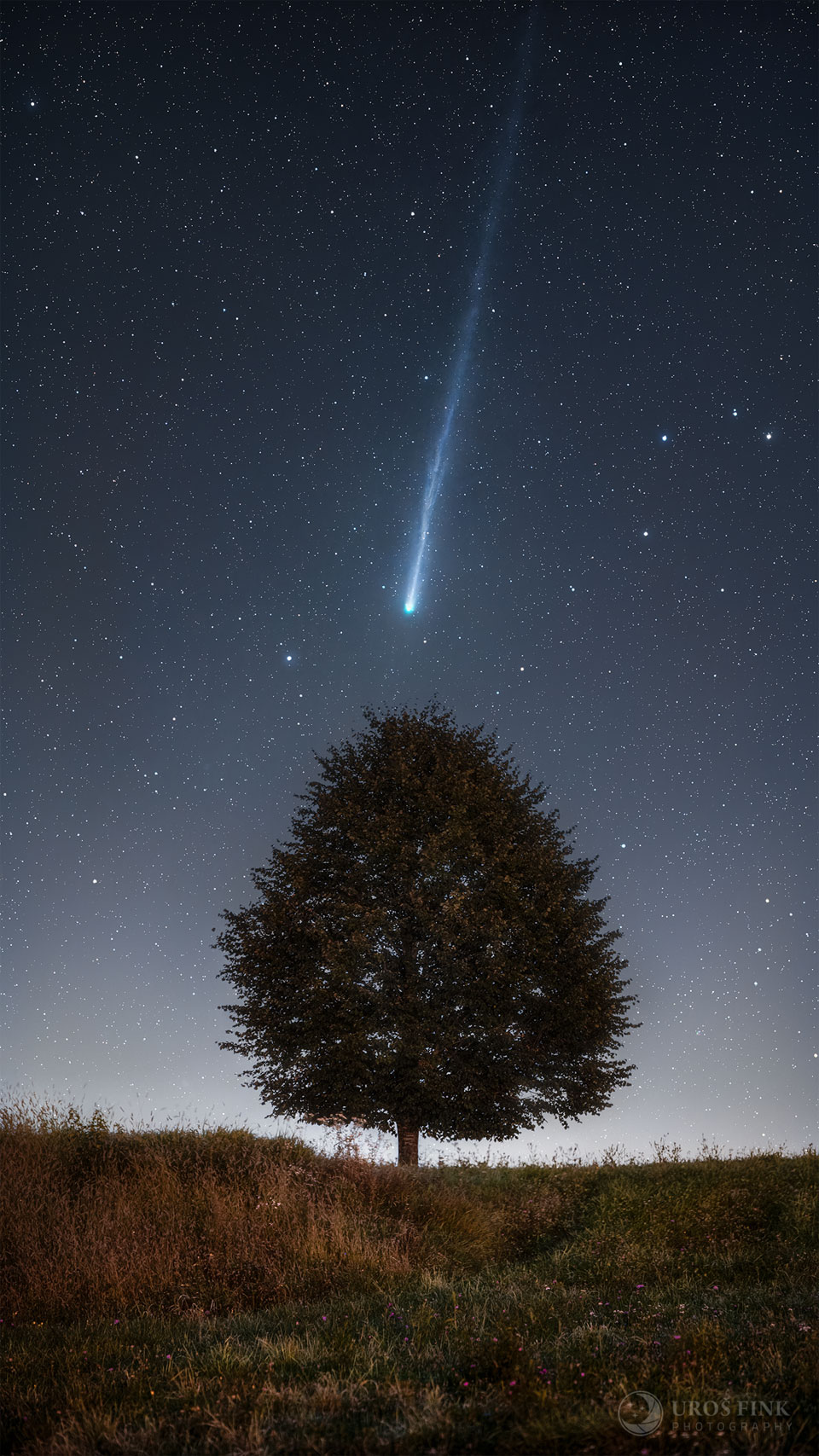
The tree is not in danger. That's because the comet pictured just above it, Comet C/2025 A6 (Lemmon), is far in the distance, well away from the Earth. Comet Lemmon now continues to brighten as it arcs through the inner Solar System, even though it has passed its nearest to the Sun -- because it is now approaching the Earth. The comet will likely appear brightest when it is at its closest to the Earth next week, then closing to about half the Earth-Sun distance. Comet Lemmon may then be visible to the unaided eye, but it is more likely to be imaged by a camera phone -- if you know where to look. Comet Lemmon, previously best visible in the morning, is now also visible in the evening sky for northern observers: look above the western horizon just after sunset. The featured image, centered on an unsuspecting European beech tree, was taken in Slovenia about ten days ago.