The Sun
The Sun is a yellow dwarf star (G2V), about 4.6 billion years old, and the dominant gravitational force in the Solar System. It has a diameter of roughly 1.4 million kilometers and contains around 99.8% of the Solar System’s mass. Nuclear fusion in its core converts hydrogen into helium, producing energy that warms the planets. Above the core lie the radiative and convective zones, followed by the visible photosphere (~5,500 °C), the chromosphere, and the much hotter corona (~2 million °C).
Source: science.nasa.gov
APODs including "The Sun"
Rocket Launch Plume over Tucson
15/10/2025
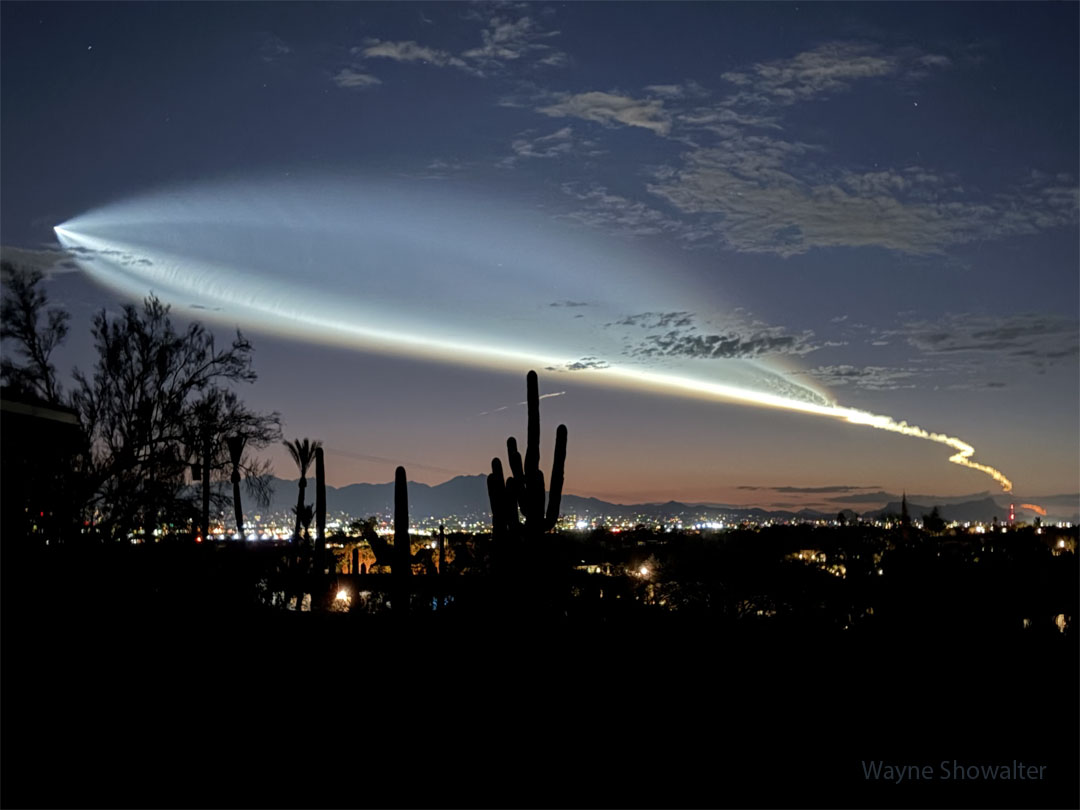
Yes, but can your sunset do this? Looking west from Tucson, Arizona, USA one day last month, the sunset sky looked strange when it briefly lit up with the plume of a rocket launched from California a few minutes earlier. Appearing at times like a giant space fish, the impressive rocket launch from Vandenberg Air Force Base near Lompoc, California, was so noticeable because it was backlit by the setting Sun. The Falcon 9 rocket successfully delivered to low Earth orbit 28 Starlink communications satellites. The plume from the first stage is seen on the right, while the soaring upper stage rocket is seen at the apex of the plume on the far left. The picturesque foreground includes the arms of saguaro cacti, city lights of Tucson, and the Tucson Mountains.