The Sun
The Sun is a yellow dwarf star (G2V), about 4.6 billion years old, and the dominant gravitational force in the Solar System. It has a diameter of roughly 1.4 million kilometers and contains around 99.8% of the Solar System’s mass. Nuclear fusion in its core converts hydrogen into helium, producing energy that warms the planets. Above the core lie the radiative and convective zones, followed by the visible photosphere (~5,500 °C), the chromosphere, and the much hotter corona (~2 million °C).
Source: science.nasa.gov
APODs including "The Sun"
3I/ATLAS Flyby
26/12/2025
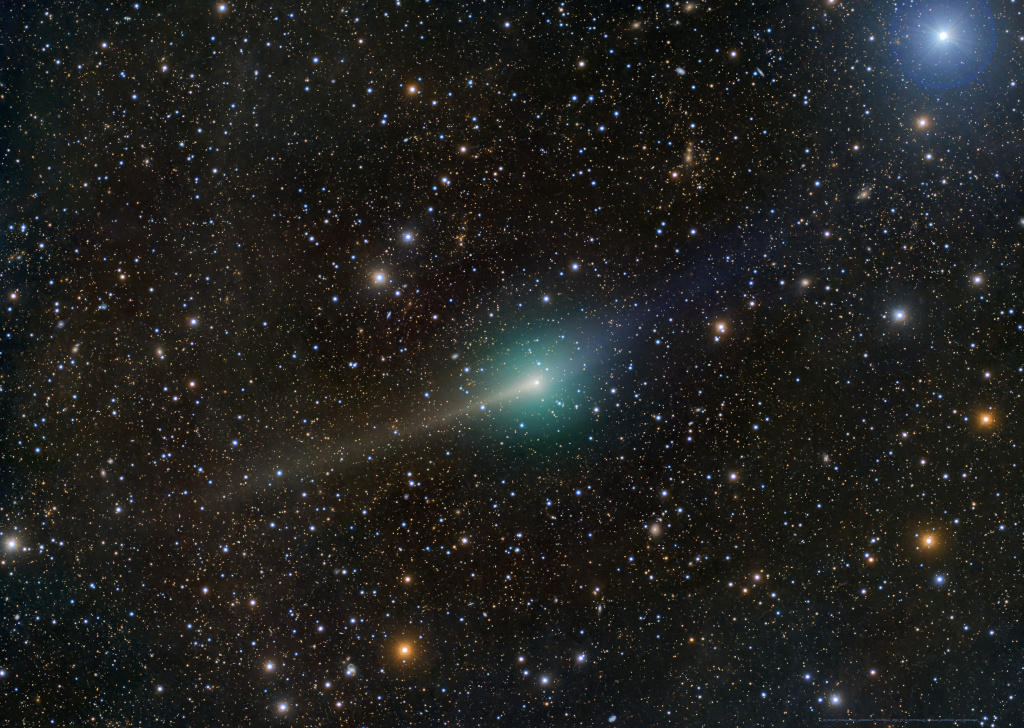
Attention grabbing interstellar visitor 3I/ATLAS made its not-so-close flyby of our fair planet on December 19 at a distance of 1.8 astronomical units. That's about 900 light-seconds. Still, this deep exposure captures the comet from another star system as it gently swept across a faint background of stars in the constellation Leo about 4 days earlier, on the night of December 15. Though faint, colors emphasized in the image data, show off the comet's yellowish dust tail and bluish ion tail along with a greenish tinged coma. And even while scrutinized by arrays of telescopes and spacecraft from planet Earth, 3I ATLAS is headed out of the Solar System. It's presently moving outward along a hyperbolic trajectory at about 64 kilometers per second relative to the Sun, too fast to be bound the Sun's gravity.