The Sun
The Sun is a yellow dwarf star (G2V), about 4.6 billion years old, and the dominant gravitational force in the Solar System. It has a diameter of roughly 1.4 million kilometers and contains around 99.8% of the Solar System’s mass. Nuclear fusion in its core converts hydrogen into helium, producing energy that warms the planets. Above the core lie the radiative and convective zones, followed by the visible photosphere (~5,500 °C), the chromosphere, and the much hotter corona (~2 million °C).
Source: science.nasa.gov
APODs including "The Sun"
NanoSail-D2
02/01/2026
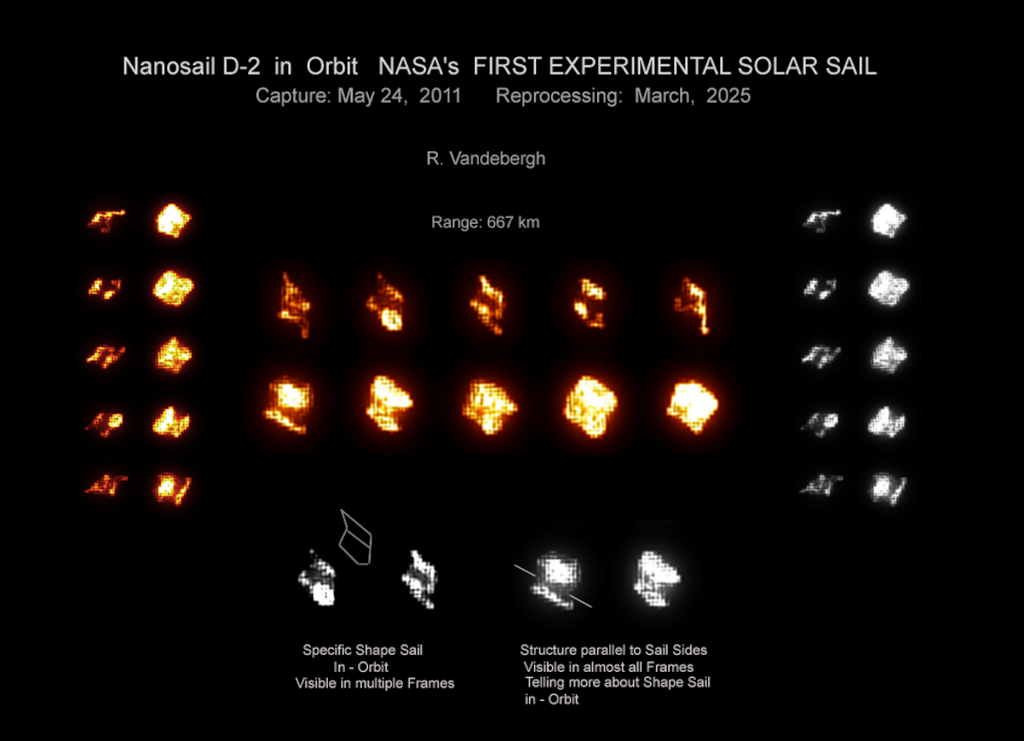
In 2011, on January 20, NASA's NanoSail-D2 unfurled a very thin and very reflective 10 square meter sail becoming the first solar sail spacecraft in low Earth orbit. Often considered the stuff of science fiction, sailing through space was suggested 400 years ago by astronomer Johannes Kepler, who had observed comet tails blown by the solar wind. But modern solar sail spacecraft designs, like NanoSail-D2, Japan's interplanetary spacecraft IKAROS, or the Planetary Society's Lightsail A, rely on the small but continuous pressure from sunlight itself for thrust. Glinting in the sunlight as it circled planet Earth, NanoSail-D2's solar sail was periodically bright and visible to the eye. These remarkably detailed images were captured by manually tracking the orbiting solar sail spacecraft with a small telescope.