The Sun
The Sun is a yellow dwarf star (G2V), about 4.6 billion years old, and the dominant gravitational force in the Solar System. It has a diameter of roughly 1.4 million kilometers and contains around 99.8% of the Solar System’s mass. Nuclear fusion in its core converts hydrogen into helium, producing energy that warms the planets. Above the core lie the radiative and convective zones, followed by the visible photosphere (~5,500 °C), the chromosphere, and the much hotter corona (~2 million °C).
Source: science.nasa.gov
APODs including "The Sun"
Active Sunspot Region 4366 Crosses the Sun
08/02/2026
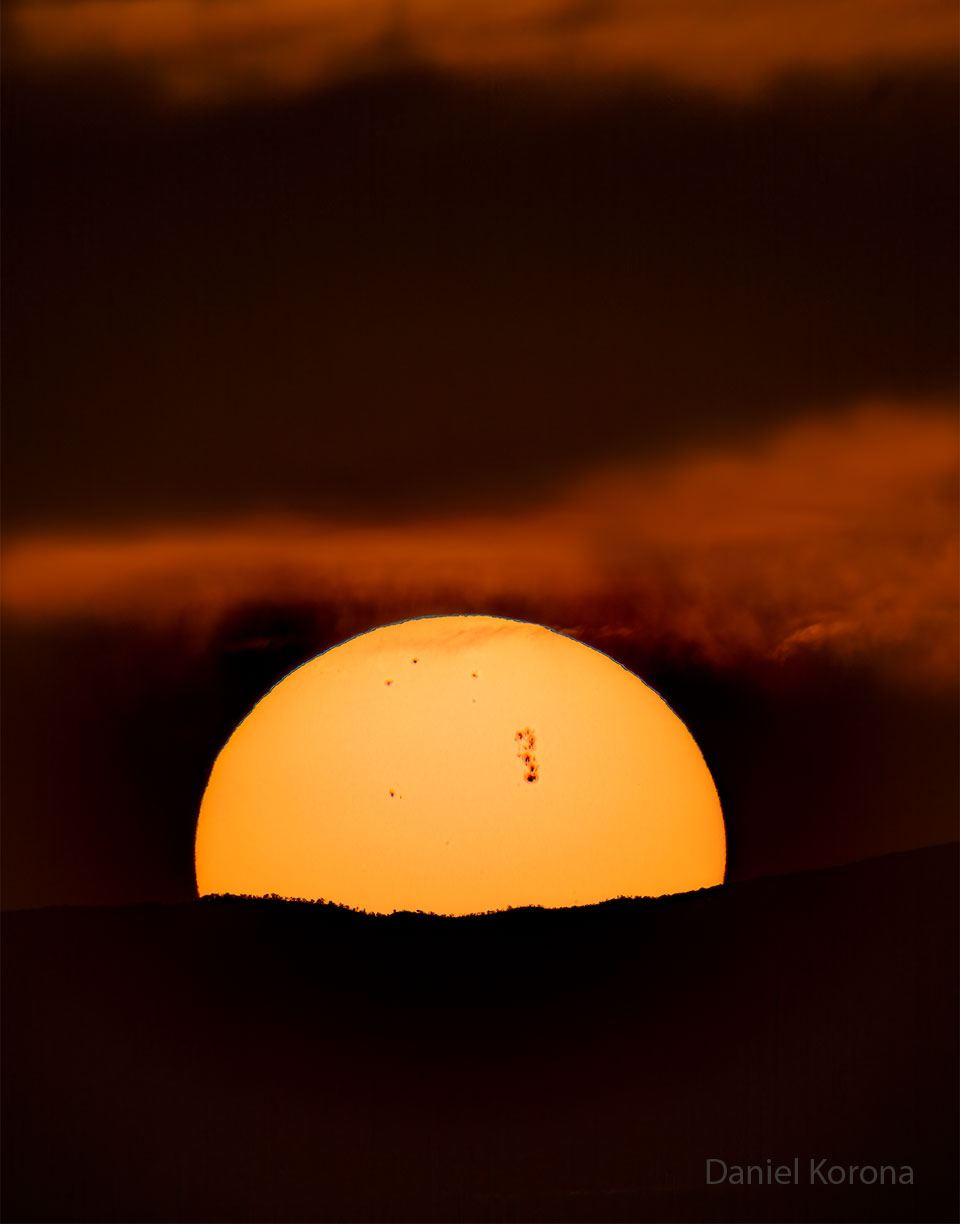
An unusually active sunspot region is now crossing the Sun. The region, labelled AR 4366, is much larger than the Earth and has produced several powerful solar flares over the past ten days. In the featured image, the region is marked by large and dark sunspots toward the upper right of the Sun's disk. The image captured the Sun over a hill in Zacatecas, Mexico, 5 days ago. AR 4366 has become a candidate for the most active solar region in this entire 11-year solar cycle. Active solar regions are frequently associated with increased auroral activity on the Earth. Now reaching the edge, AR 4366 will begin facing away from the Earth during the coming week. It is not known, though, if the active region will survive long enough to reappear in about two weeks' time, as the Sun rotates.