The Sun
The Sun is a yellow dwarf star (G2V), about 4.6 billion years old, and the dominant gravitational force in the Solar System. It has a diameter of roughly 1.4 million kilometers and contains around 99.8% of the Solar System’s mass. Nuclear fusion in its core converts hydrogen into helium, producing energy that warms the planets. Above the core lie the radiative and convective zones, followed by the visible photosphere (~5,500 °C), the chromosphere, and the much hotter corona (~2 million °C).
Source: science.nasa.gov
APODs including "The Sun"
CG 4: The Globule and the Galaxy
11/03/2026
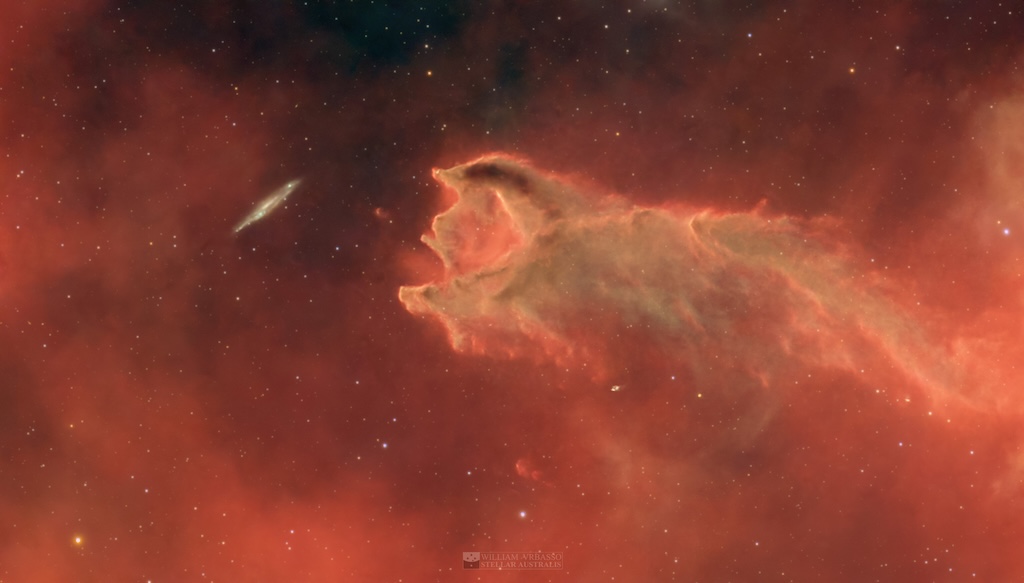
Is this a cosmic monster ready to devour an unsuspecting galaxy? Thankfully, that is not the case. The red “monster” shown in the featured image is Cometary Globule CG 4, 1,300 light-years away in the Constellation Puppis. CG 4 is a molecular cloud, where hydrogen becomes cold enough to form molecules that can be brought together by gravity to create stars. The shape of CG 4 resembles that of a comet, but its head is 1.5 light-year in diameter and its tail is 8 light-years long; for comparison, the distance from the Earth to the sun is only 8 light-minutes. Astronomers believe that the tail of a cometary globule could have been shaped by a nearby supernova explosion or by irradiation from hot, massive stars. Indeed, CG 4 and other nearby globules point away from the Vela Supernova Remnant, at the center of the Gum Nebula. The edge-on spiral galaxy, ESO 257-19, is more than a hundred million light-years beyond CG 4, and is completely safe from the “monster”.