The Sun
The Sun is a yellow dwarf star (G2V), about 4.6 billion years old, and the dominant gravitational force in the Solar System. It has a diameter of roughly 1.4 million kilometers and contains around 99.8% of the Solar System’s mass. Nuclear fusion in its core converts hydrogen into helium, producing energy that warms the planets. Above the core lie the radiative and convective zones, followed by the visible photosphere (~5,500 °C), the chromosphere, and the much hotter corona (~2 million °C).
Source: science.nasa.gov
APODs including "The Sun"
The Claw and Bubble Nebulae
01/04/2026
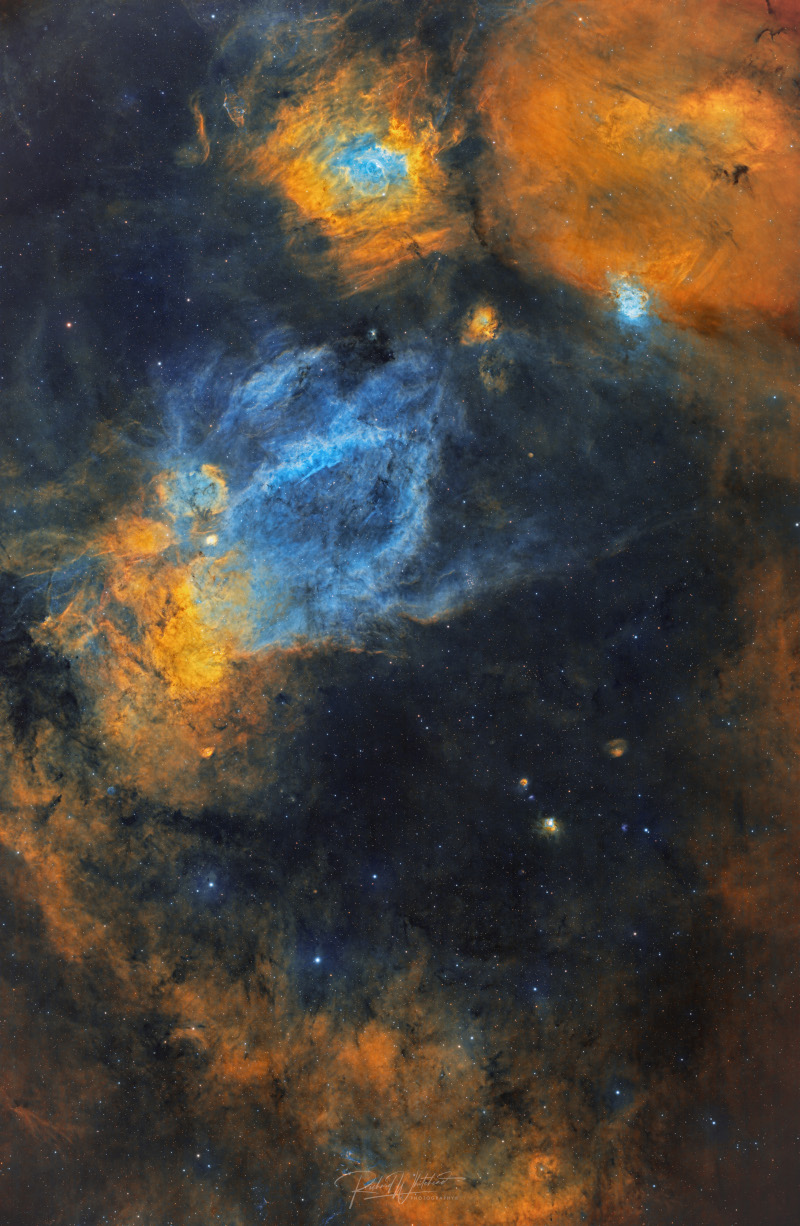
What unexpected things do you see when you look up at the night sky? Today’s image resembles an abstract painting, with large swaths of color strewn across a cosmic canvas seemingly without design. Despite the image's abstract nature, the human mind finds patterns, identifying a large claw reaching up towards a floating bubble. Embedded within these seemingly random structures are the physical laws that govern how light and matter interact. The Claw (Sh2-157) and Bubble (NGC 7635) Nebulae glow colors that are mapped to the yellow and blue shown, indicating the presence of hydrogen and oxygen ionized by the intense light emitted from stars several times the mass of the Sun. This image depicts both the chaos and structure of astronomical processes, showing that a common thread between art and science is to look for the unexpected.