The Sun
The Sun is a yellow dwarf star (G2V), about 4.6 billion years old, and the dominant gravitational force in the Solar System. It has a diameter of roughly 1.4 million kilometers and contains around 99.8% of the Solar System’s mass. Nuclear fusion in its core converts hydrogen into helium, producing energy that warms the planets. Above the core lie the radiative and convective zones, followed by the visible photosphere (~5,500 °C), the chromosphere, and the much hotter corona (~2 million °C).
Source: science.nasa.gov
APODs including "The Sun"
Hello World
04/04/2026
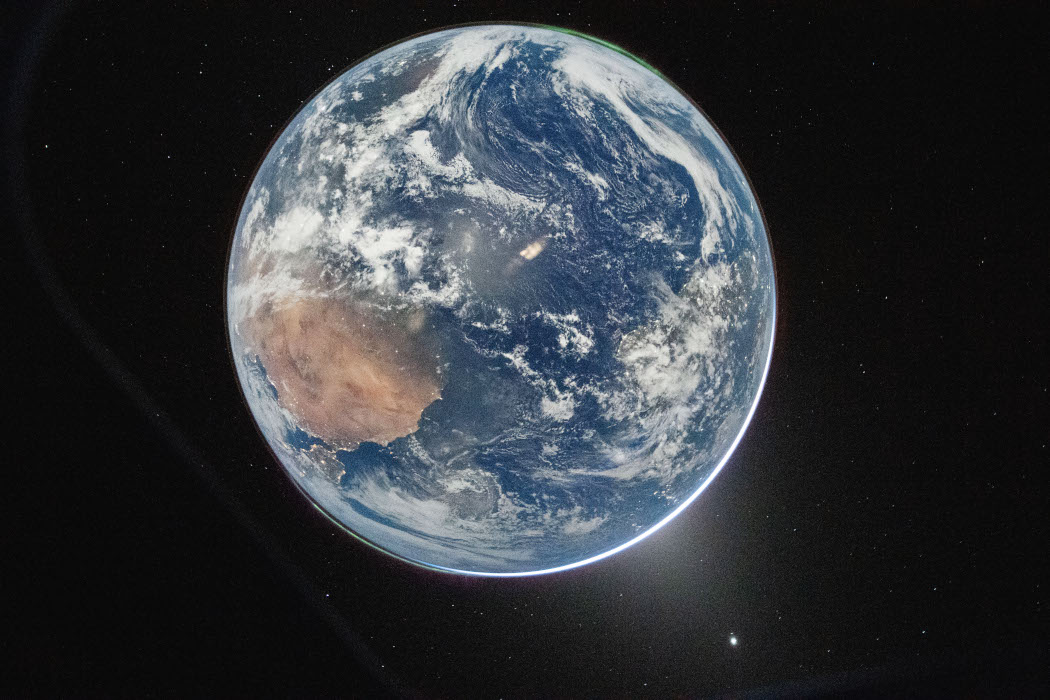
From pole to pole our fair planet is captured in this snapshot from space, an evocative image from a window of the Orion spacecraft Integrity. From the spacecraft's perspective the Sun is moving behind Earth's bright limb along the lower right. Africa and the Iberian peninsula are in view on the pale blue planet's surface, while aurorae crown Earth's south and north poles at top right and bottom left. Commander Reid Wiseman took the historic picture on Artemis II mission flight day 2 (April 2), after the completion of the planned translunar injection burn. That burn boosted the spacecraft out of Earth orbit, sending Integrity and crew on a trajectory that will take them around the Moon and back again. That's a journey humans last made over 50 years ago.