The Sun
The Sun is a yellow dwarf star (G2V), about 4.6 billion years old, and the dominant gravitational force in the Solar System. It has a diameter of roughly 1.4 million kilometers and contains around 99.8% of the Solar System’s mass. Nuclear fusion in its core converts hydrogen into helium, producing energy that warms the planets. Above the core lie the radiative and convective zones, followed by the visible photosphere (~5,500 °C), the chromosphere, and the much hotter corona (~2 million °C).
Source
APODs including "The Sun"
Comet R3 PanSTARRS and Orion
10 May 2026
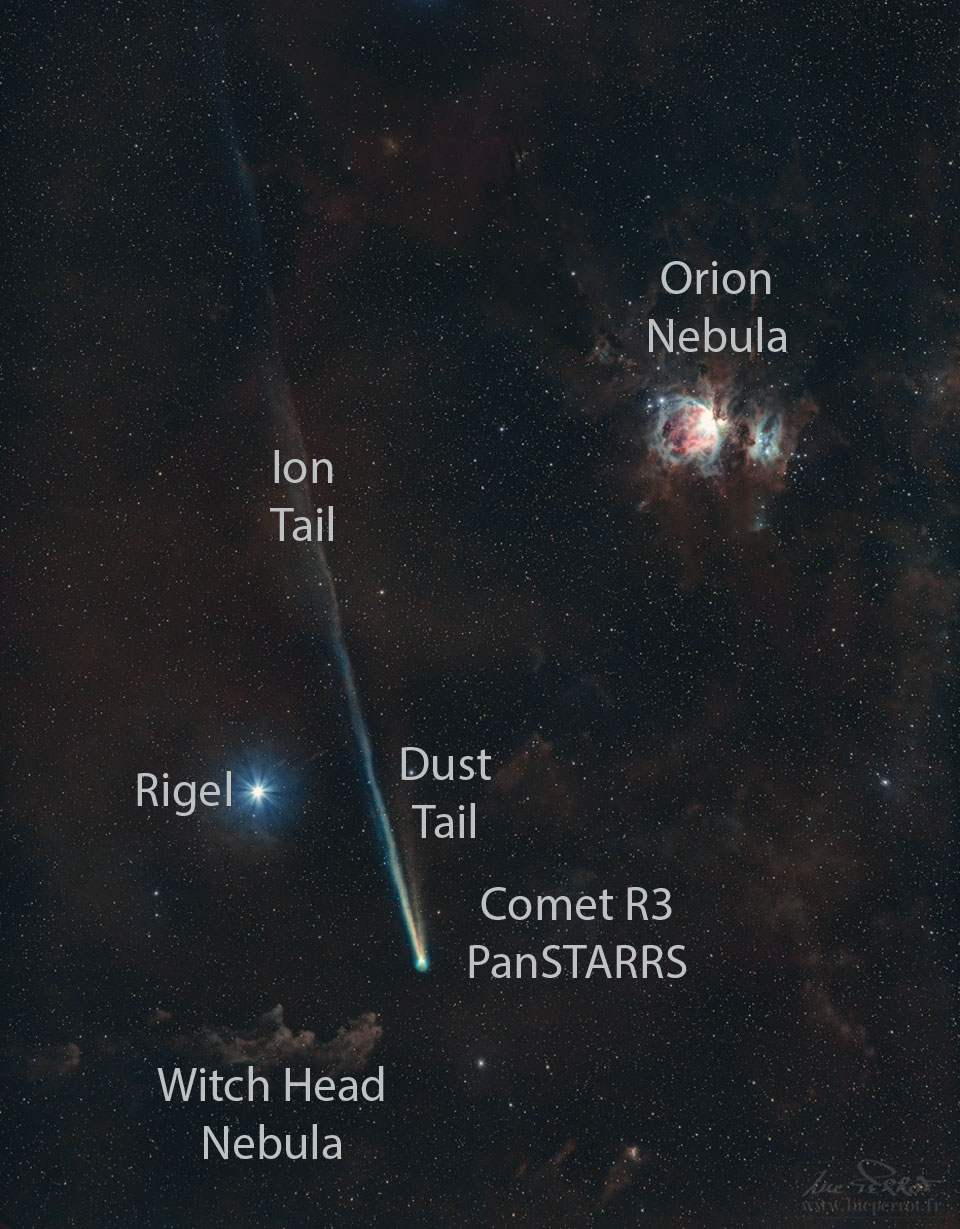
Orion never had a sword like this. As Comet C/2025 R3 (PanSTARRS) heads out of the inner Solar System, it is putting on quite a show for long exposure cameras. Currently seen toward the constellation of Orion the Hunter, the distant Orion Nebula is visible on the upper right. Comet R3 PanSTARRS is now showing two distinct tails: a short dust tail pointing toward the top of the image and a long and wavy ion tail trailing off toward the upper left. The ion tail points away from the Sun and glows blue from excited carbon monoxide. Large particles in the dust tail somewhat resist the radiation pressure that push them away from the Sun and so retain a bit of the comet's orbit. The dust tail shines by reflected sunlight. The featured image was taken a few days ago from France's Reunion Island in the southern Indian Ocean. Growing Gallery: Comet R3 PanSTARRS in 2026