The Sun
The Sun is a yellow dwarf star (G2V), about 4.6 billion years old, and the dominant gravitational force in the Solar System. It has a diameter of roughly 1.4 million kilometers and contains around 99.8% of the Solar System’s mass. Nuclear fusion in its core converts hydrogen into helium, producing energy that warms the planets. Above the core lie the radiative and convective zones, followed by the visible photosphere (~5,500 °C), the chromosphere, and the much hotter corona (~2 million °C).
Source
APODs including "The Sun"
Anticrepuscular Rays over Sicily
25 June 2026
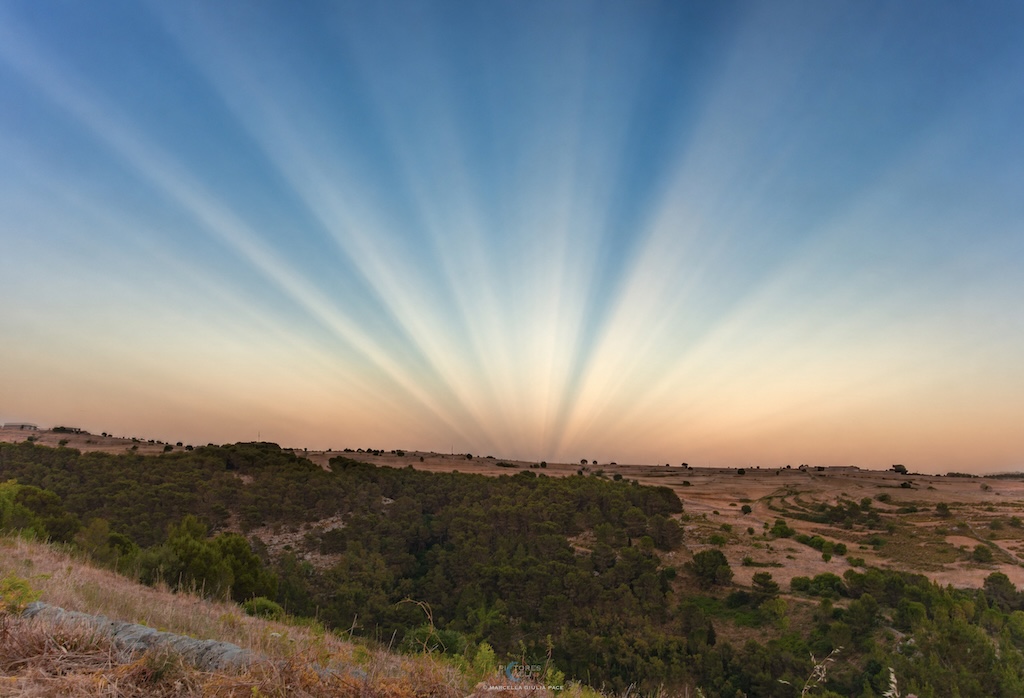
The Sun has just set... in the opposite side of the sky. Pictured here are anticrepuscular rays apparently converging in the east in this image of the limestone plateau in the heart of the Hyblaean Mountains of southeastern Sicily, in Italy. How were these anticrepuscular rays formed, if the Sun wasn't there? After the Sun set (in the west, as usual) its light still illuminated a cloud higher up in the sky. Partially blocked by the cloud, the sunlight produced patterns of light and shadow, crossing the sky in parallel lines. Perspective makes it look like they converge in the east, in the same way that train tracks appear to meet in the distance. This effect can also happen at sunrise, only the directions are exchanged. In rare cases, both crepuscular and anticrepuscular rays can be seen at the same time.