The Sun
The Sun is a yellow dwarf star (G2V), about 4.6 billion years old, and the dominant gravitational force in the Solar System. It has a diameter of roughly 1.4 million kilometers and contains around 99.8% of the Solar System’s mass. Nuclear fusion in its core converts hydrogen into helium, producing energy that warms the planets. Above the core lie the radiative and convective zones, followed by the visible photosphere (~5,500 °C), the chromosphere, and the much hotter corona (~2 million °C).
Source: science.nasa.gov
APODs including "The Sun"
The Dust Trail of Comet Tempel 2
17/07/2026
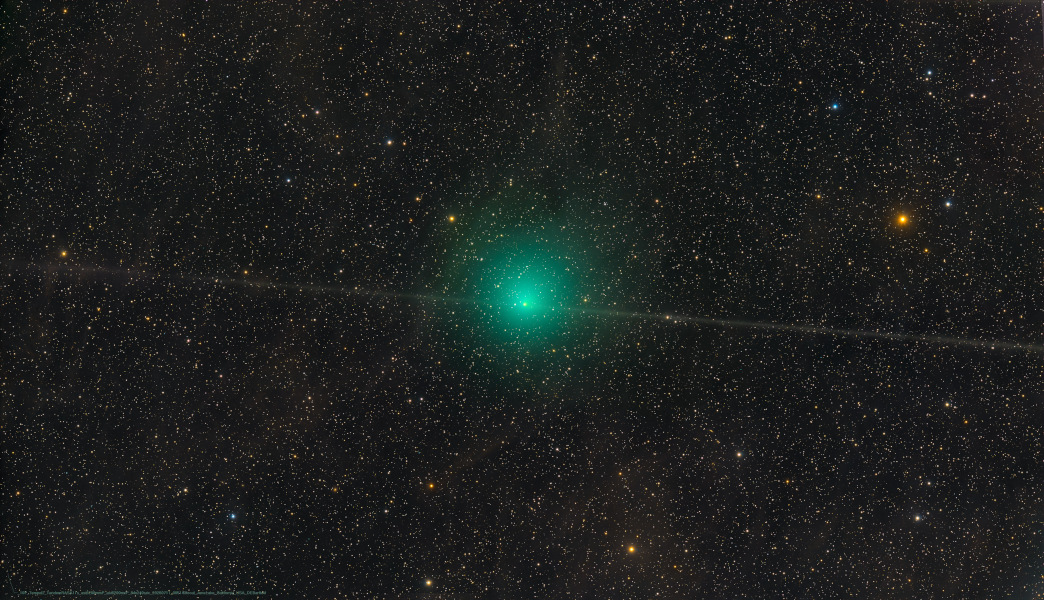
Comet 10P/Tempel 2 orbits the Sun once every 5.4 years. Currently visible in binoculars or small telescopes toward the constellation Capricornus, the periodic comet is captured in this sharp telescopic image from July 11 sporting a bright nuclear region and pretty greenish coma. Remarkably, a thin dust trail, not a typical dust tail, is also seen extending both east and west of the Tempel 2 nucleus. Unlike a comet dust tail, which tends to temporarily fan out in a direction away from the Sun, this dust trail is due to the residual dust shed during many past orbits along this ancient periodic comet's orbital plane. In fact, Tempel 2's dust trail may get a little narrower and brighter from our perspective as Earth crosses through the comet's orbital plane on July 20. Comet 10P/Tempel 2 will reach a perihelion on August 2, and make its closest approach to Earth on August 3.