Titan
Saturn's largest moon and the second-largest in the Solar System. Titan is unique for its dense nitrogen-rich atmosphere and the presence of liquid hydrocarbon lakes and rivers on its surface.
Source: science.nasa.gov
APODs including "Titan"
Uranus's Moon Oberon: Impact World
08/04/1996
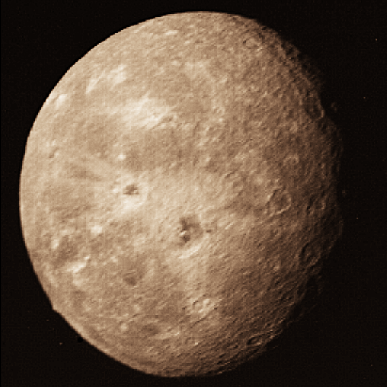
Oberon is the most distant and second largest moon of Uranus. Discovered by William Herschel in 1787, the properties of the world remained relatively unknown until the robot spacecraft Voyager 2 passed it during its flyby of Uranus in January 1986. Compared to Uranus' moons Ariel, Titania, and Miranda, Oberon is heavily cratered, and in this way resembles Umbriel. Like all of Uranus' large moons, Oberon is composed of roughly half ice and half rock. Note that Oberon has at least one large mountain, visible on the limb at the lower left, that rises 6 km off the surface. Latest Comet Hyakutake images: APOD Hyakutake Archive, JPL, Fayetteville Observer-Times, NASA's Night of the Comet, ICSTARS, Jerry Lodriguss, ScienceWeb, Crni Vrh Obs., Cent. Mich. U.