Triton
Triton is the largest of Neptune's 13 moons and is unique due to its retrograde orbit, meaning it orbits Neptune in the opposite direction of the planet's rotation. Scientists believe Triton was a Kuiper Belt Object captured by Neptune's gravity millions of years ago.
Source: science.nasa.gov
APODs including "Triton"
Neptune's Moon Proteus
04/11/1995
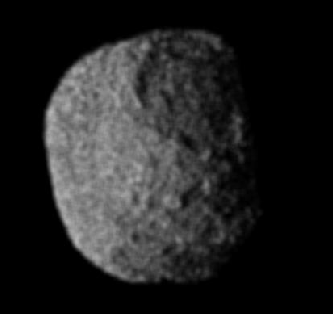
Proteus is the second largest moon of Neptune behind the mysterious Triton. Proteus was discovered only in 1982 by the Voyager 2 spacecraft. This is unusual since Neptune has a smaller moon - Nereid - which was discovered 33 years earlier from Earth. The reason Proteus was not discovered sooner is that its surface is very dark and it orbits much closer to Neptune. Proteus has an odd box-like shape and were it even slightly more massive, its own gravity would cause it to reform itself into a sphere.