Triton
Triton is the largest of Neptune's 13 moons and is unique due to its retrograde orbit, meaning it orbits Neptune in the opposite direction of the planet's rotation. Scientists believe Triton was a Kuiper Belt Object captured by Neptune's gravity millions of years ago.
Source
APODs including "Triton"
Triton: Neptune's Largest Moon
10 October 1996
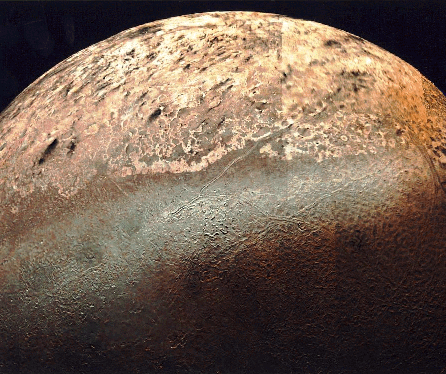
Today marks the 150th anniversary of the discovery of Triton. On October 10 1846, William Lassell was observing the newly discovered planet Neptune. He was attempting to confirm his observation, made just the previous week, that Neptune had a ring. But this time he discovered that Neptune had a satellite as well. Lassell soon proved the ring was product of his new telescope's distortion, but the satellite Triton remained. The above picture of Triton was taken in 1989 by the only spacecraft ever to pass Triton: Voyager 2. Voyager 2 found fascinating terrain, a thin atmosphere, and even evidence for ice volcanoes on this world of peculiar orbit and spin. Ironically, Voyager 2 also confirmed the existence of complete thin rings around Neptune - but these would have been quite invisible to Lassell!