Triton
Triton is the largest of Neptune's 13 moons and is unique due to its retrograde orbit, meaning it orbits Neptune in the opposite direction of the planet's rotation. Scientists believe Triton was a Kuiper Belt Object captured by Neptune's gravity millions of years ago.
Source: science.nasa.gov
APODs including "Triton"
Ringed Ice Giant Neptune
23 September 2022
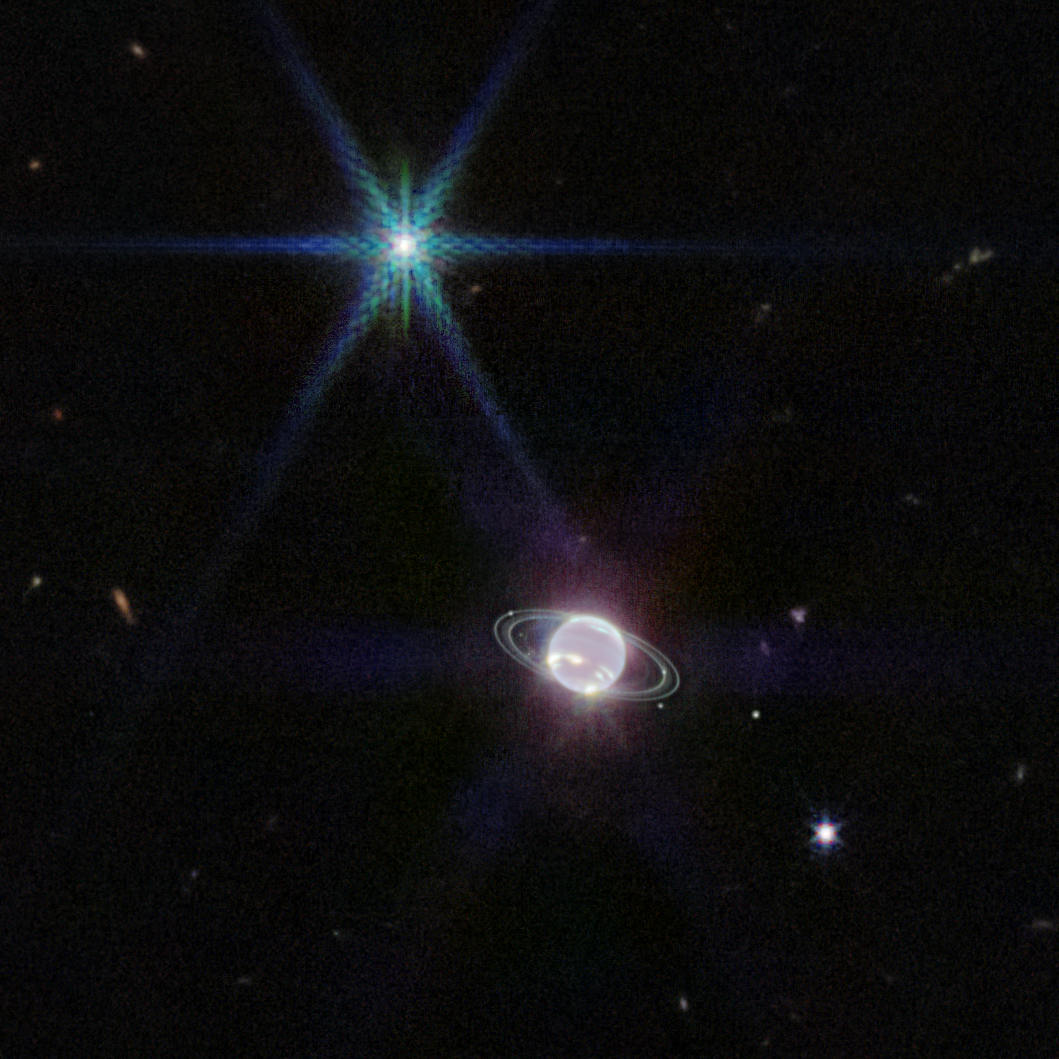
Ringed, ice giant Neptune lies near the center of this sharp near-infrared image from the James Webb Space Telescope. The dim and distant world is the farthest planet from the Sun, about 30 times farther away than planet Earth. But in the stunning Webb view the planet's dark and ghostly appearance is due to atmospheric methane that absorbs infrared light. High altitude clouds that reach above most of Neptune's absorbing methane easily stand out in the image though. Coated with frozen nitrogen, Neptune's largest moon Triton is brighter than Neptune in reflected sunlight and is seen at upper left sporting the Webb's characteristic diffraction spikes. Including Triton, seven of Neptune's 14 known moons can be identified in the field of view. Neptune's faint rings are striking in this new space-based planetary portrait. Details of the complex ring system are seen here for the first time since Neptune was visited by the Voyager 2 spacecraft in August 1989.