Ultraviolet Light
Electromagnetic radiation with wavelengths shorter than visible light but longer than X-rays. Ultraviolet observations are crucial for studying hot astronomical objects like accretion disks around black holes.
Source: science.nasa.gov
APODs including "Ultraviolet Light"
Globular Cluster M15
10/12/2001
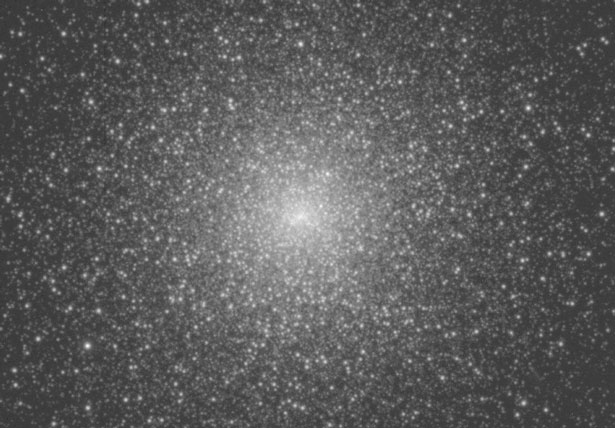
Stars, like bees, swarm around the center of bright globular cluster M15. This ball of over 100,000 stars is a relic from the early years of our Galaxy, and continues to orbit the Milky Way's center. M15, one of about 150 globular clusters remaining, is noted for being easily visible with only binoculars, having at its center one of the densest concentrations of stars known, and containing a high abundance of unusual variable stars and pulsars. The above image, taken in ultraviolet light with the WIYN Telescope, spans about 120 light years and shows the gradual increase in stars toward the cluster's center. M15 lies about 35,000 light years away toward the constellation of Pegasus. Recent evidence indicates that a massive black hole might reside as the center of M15.