Ursa Major
Ursa Major, Latin for 'Great Bear,' is a prominent constellation in the northern sky. It is the third-largest constellation and contains the Big Dipper asterism, which is often used as a navigational aid due to its proximity to Polaris, the North Star.
Source: science.nasa.gov
APODs including "Ursa Major"
Quadrantids: Meteors in Perspective
26/01/1996
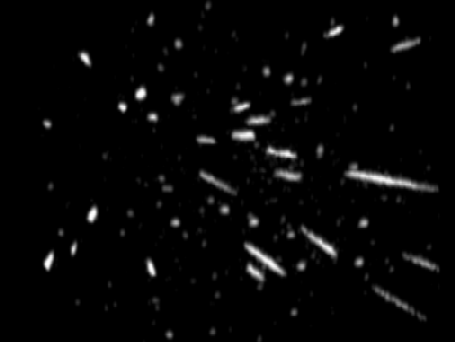
Meteor showers are caused by streams of solid particles, dust size and larger, moving as a group through space. In many cases, the orbits of these meteor streams can be identified with the dust tails of comets. When the Earth passes through the streams, the particles leave brilliant trails through the night sky as they burn up in the atmosphere. Above is an image of a meteor shower known as the Quadrantids. It was made in January 1995 using MOVIE, a new system for making video meteor observations. To make the image, frames from a video tape were computer processed and superposed to show the relative paths of many meteors in the shower. The meteor paths are all parallel to each other, but the effect of perspective causes the trails to appear to originate from a distant radiant point in the sky. In contrast to the elongated meteor trails, the brighter stars of the familiar constellation Ursa Major (the Big Dipper) are visible as points in the lower half of the image.