Ursa Major
Ursa Major, Latin for 'Great Bear,' is a prominent constellation in the northern sky. It is the third-largest constellation and contains the Big Dipper asterism, which is often used as a navigational aid due to its proximity to Polaris, the North Star.
Source: science.nasa.gov
APODs including "Ursa Major"
A Deep Field In The Southern Sky
02/12/1998
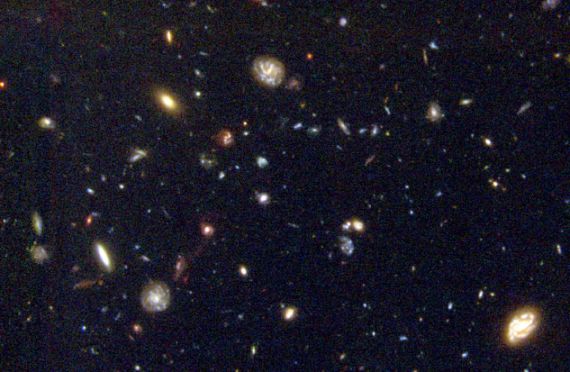
This new deep view of the cosmos is the sequel to the 1995 hit Hubble Space Telescope Deep Field. Billed as the Hubble Deep Field South, it was produced by pointing the space telescope toward a patch of sky in the southern constellation Tucana. Over a period of 10 days, many separate exposures were accumulated and combined to reveal progressively fainter galaxies. The original deep field was constructed by observing a piece of sky in the northern constellation Ursa Major. Both stare down 12 billion light-year long tunnels to far-off and still mysterious times when young galaxies inhabited an infant universe. Hubble Deep Field South observations were released to an enthusiastic audience on November 23, 1998.