Ursa Major
Ursa Major, Latin for 'Great Bear,' is a prominent constellation in the northern sky. It is the third-largest constellation and contains the Big Dipper asterism, which is often used as a navigational aid due to its proximity to Polaris, the North Star.
Source: science.nasa.gov
APODs including "Ursa Major"
Messier 109
23/05/2013
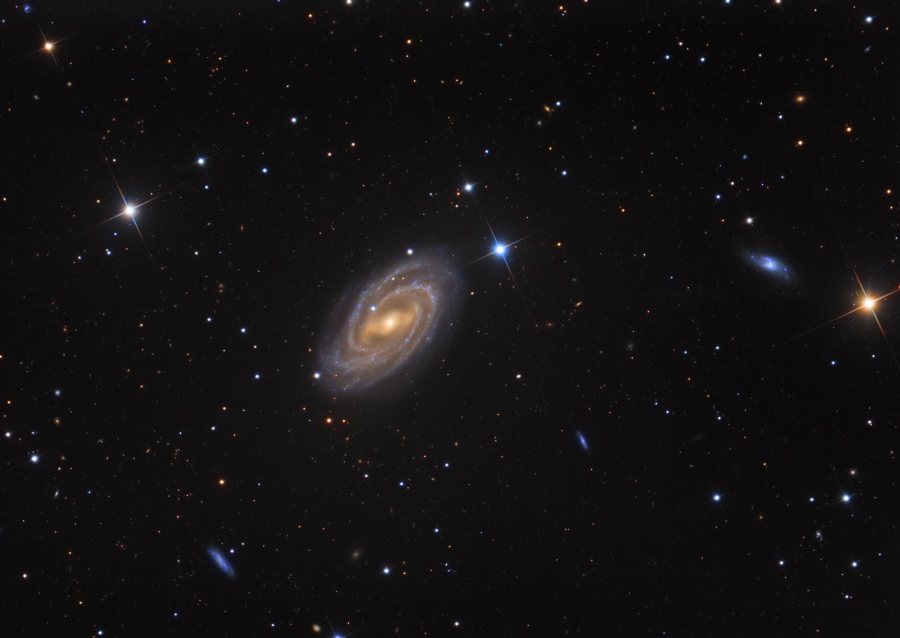
Beautiful barred spiral galaxy M109, 109th entry in Charles Messier's famous catalog of bright Nebulae and Star Clusters, is found just below the Big Dipper's bowl in the northern constellation Ursa Major. In telescopic views, its striking central bar gives the galaxy the appearance of the Greek letter "theta", θ, a common mathematical symbol representing an angle. Of course M109 spans a very small angle in planet Earth's sky, about 7 arcminutes or 0.12 degrees. But that small angle corresponds to an enormous 120,000 light-year diameter at the galaxy's estimated 60 million light-year distance. The brightest member of the now recognized Ursa Major galaxy cluster, M109 (aka NGC 3992) is joined by three spiky foreground stars strung out across this frame. The three small, fuzzy bluish galaxies also on the scene, identified left to right as UGC 6969, UGC 6940 and UGC 6923, are possibly satellite galaxies of the larger M109.