Ursa Major
Ursa Major, Latin for 'Great Bear,' is a prominent constellation in the northern sky. It is the third-largest constellation and contains the Big Dipper asterism, which is often used as a navigational aid due to its proximity to Polaris, the North Star.
Source: science.nasa.gov
APODs including "Ursa Major"
Messier 81
12/03/2021
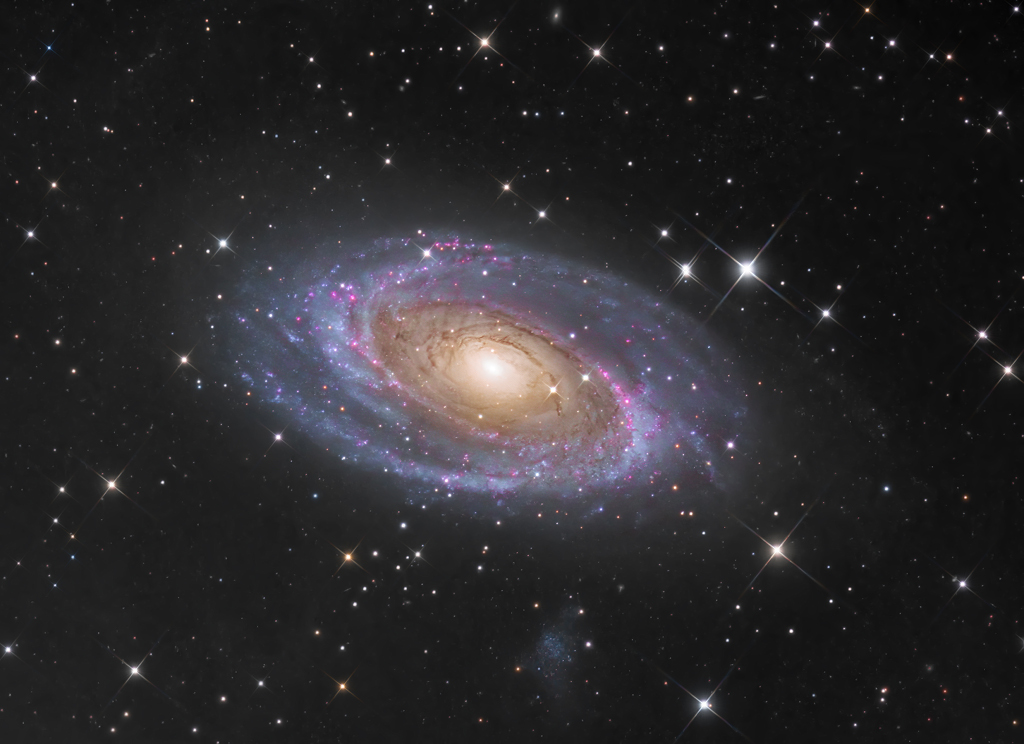
One of the brightest galaxies in planet Earth's sky is similar in size to our Milky Way Galaxy: big, beautiful Messier 81. Also known as NGC 3031 or Bode's galaxy for its 18th century discoverer, this grand spiral can be found toward the northern constellation of Ursa Major, the Great Bear. The sharp, detailed telescopic view reveals M81's bright yellow nucleus, blue spiral arms, pinkish starforming regions, and sweeping cosmic dust lanes. Some dust lanes actually run through the galactic disk (left of center), contrary to other prominent spiral features though. The errant dust lanes may be the lingering result of a close encounter between M81 and the nearby galaxy M82 lurking outside of this frame. M81's faint, dwarf irregular satellite galaxy, Holmberg IX, can be seen just below the large spiral. Scrutiny of variable stars in M81 has yielded a well-determined distance for an external galaxy -- 11.8 million light-years.