Ursa Major
Ursa Major, Latin for 'Great Bear,' is a prominent constellation in the northern sky. It is the third-largest constellation and contains the Big Dipper asterism, which is often used as a navigational aid due to its proximity to Polaris, the North Star.
Source: science.nasa.gov
APODs including "Ursa Major"
Comet Olbers over Kunetice Castle
01/08/2024
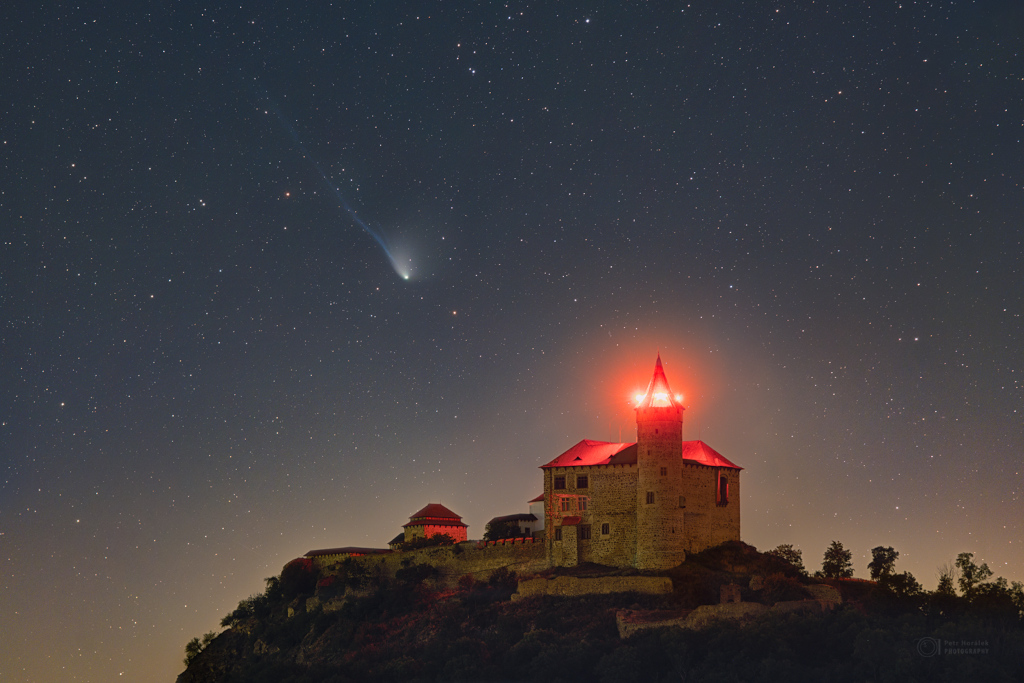
A visitor to the inner solar system every 70 years or so, Comet 13P/Olbers reached its most recent perihelion, or closest approach to the Sun, on June 30. Now on a return voyage to the distant Oort Cloud, the Halley-type comet is recorded here sweeping through northern summer night skies over historic Kunetice Castle, Czech Republic. The composite of tracked exposures for comet and sky, showing the comet's broad dust tail, brighter coma, and long ion tail buffeted by storms and winds from the Sun, and fixed exposures for foreground landscape was recorded on July 28. The comet is about 16 light-minutes beyond the castle and seen against faint background stars below the northern constellation Ursa Major. The hilltop castle dates to the 15th century, while Heinrich Olbers discovered the comet in 1815. Captured here low in northwestern skies just after sunset Comet Olbers, for now, offers skywatchers on planet Earth rewarding telescopic and binocular views. Comet 13P/Olbers' next perihelion passage will be in 2094.