Venus
The second planet from the Sun and one of the brightest objects in Earth’s night sky. Venus is often visible near sunrise or sunset and is commonly referred to as the 'morning star' or 'evening star.'
Source: solarsystem.nasa.gov
APODs including "Venus"
A World Explorer
25/08/1995
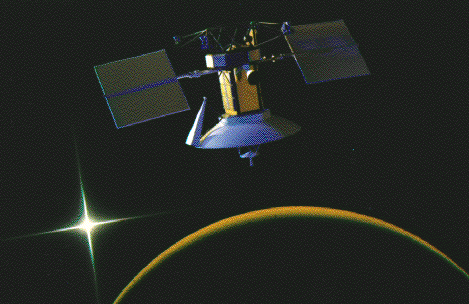
August 25, 1995 A World Explorer Credit: NASA, JPL Magellan Project Explanation: Ferdinand Magellan was a world explorer. Many consider him the greatest navigator of Europe's 16th century age of sea going exploration and credit his expedition with the first circumnavigation of planet Earth. NASA's Venus probe, the aptly named Magellan spacecraft shown above in an artist's conception, provided a global view of the poorly known surface of Venus - just as Magellan's expedition provided the beginnings of a global perspective of the Earth. Ferdinand Magellan's expedition of 5 ships and 265 men left Spain in 1519 in search of a western route to the Spice Islands of Indonesia. In 1522 one ship and 17 men returned. NASA launched the Magellan probe on May 4, 1989. Placed in a polar orbit, Magellan's many circumnavigations resulted in a detailed radar mapping of 98% of the Venusian surface. As pictured, the radar mapper's antenna resembles a large inverted bowl. Power for the radar was produced by the wing like solar panels. In October of 1994, the Magellan probe entered the Venusian atmosphere and ground controllers lost contact with the spacecraft.