Venus
The second planet from the Sun and one of the brightest objects in Earth’s night sky. Venus is often visible near sunrise or sunset and is commonly referred to as the 'morning star' or 'evening star.'
Source: solarsystem.nasa.gov
APODs including "Venus"
The North Pole of Venus
14/05/2003
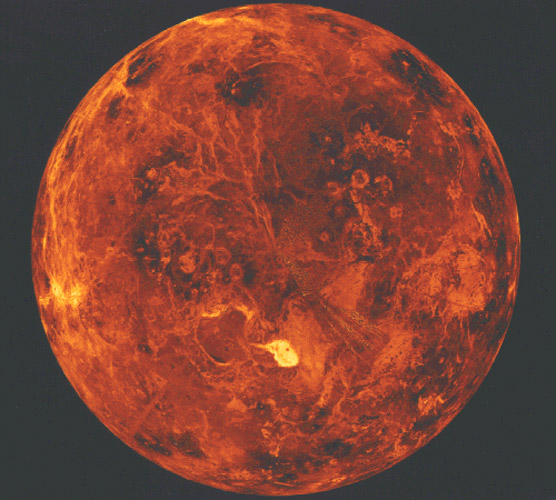
If you could look down on the North Pole of Venus what would you see? The Magellan probe that orbited Venus from 1990 to 1994 was able to peer through the thick Venusian clouds and build up the above image by emitting and re-detecting cloud-penetrating radar. Visible as the bright patch below central North is Venus' highest mountain Maxwell Montes. Other notable features include numerous mountains, coronas, impact craters, tessera, ridges, and lava flows. Although the size and mass of Venus are similar to the Earth, its thick carbon-dioxide atmosphere has trapped heat so efficiently that surface temperature usually exceeds 700 kelvins, hot enough to melt lead. News: Are you ready for tomorrow's lunar eclipse? Times | Webcast | Photo Tips