Venus
The second planet from the Sun and one of the brightest objects in Earth’s night sky. Venus is often visible near sunrise or sunset and is commonly referred to as the 'morning star' or 'evening star.'
Source: solarsystem.nasa.gov
APODs including "Venus"
Nova over Thailand
21/11/2016
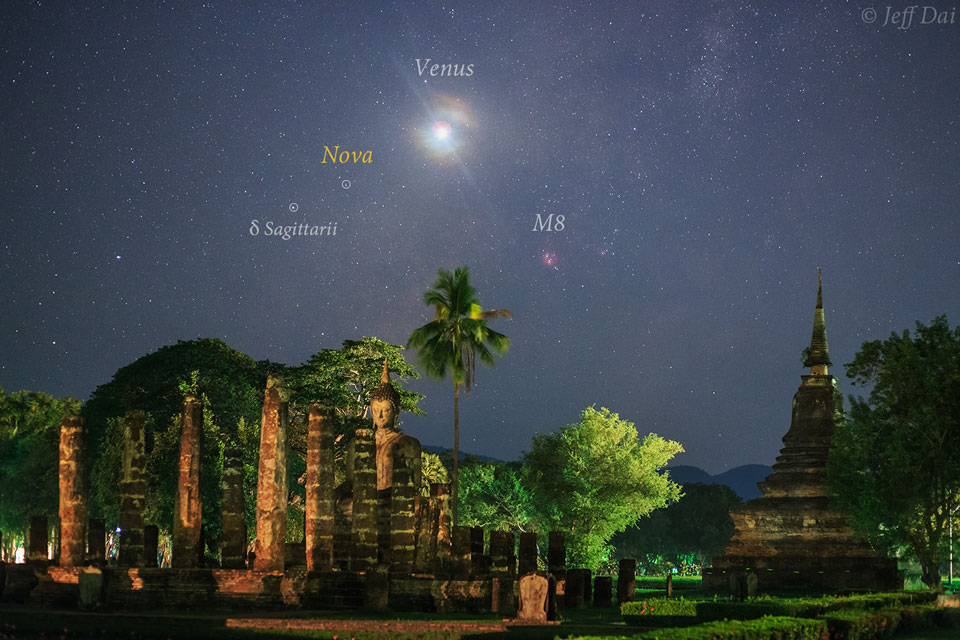
A nova in Sagittarius is bright enough to see with binoculars. Discovered last month by the All-Sky Automated Survey for Supernovae (ASAS-SN), the stellar explosion even approached the limit of naked-eye visibility last week. A classical nova results from a thermonuclear explosion on the surface of a white dwarf star -- a dense star having the size of our Earth but the mass of our Sun. In the featured image, the nova was captured last week above ancient Wat Mahathat in Sukhothai, Thailand. To see Nova Sagittarius 2016 yourself, just go out just after sunset and locate near the western horizon the constellation of the Archer (Sagittarius), popularly identified with an iconic teapot. Also visible near the nova is the very bright planet Venus. Don�t delay, though, because not only is the nova fading, but that part of the sky is setting continually closer to sunset.